Sunday, November 24, 2019

Fecal Matters

Colonoscopy story, at a salubrious level of abstraction. Can be read by the squeamish! ≈2.8K words, © ยต 2019.

    "What's the procedure?" my son Sam asked. We were speaking confidentially in the doorway of his kids' home, where we had met up to take them out to a restaurant. He was referring to the upcoming medical appointment he'd agreed to drive me to.
    I launched into words prepared to ease him gently toward the truth. "The prestige the body parts are accorded varies greatly. Most esteemed is the brain of course, then the heart …".
    "Is it a colonoscopy?", he said, cutting me short, but softening the brusqueness with an eye roll mixing affection with impatience.
    "Well, yes … but there's only a 5% chance of cancer." He gave me a hug and a clap on the back.
…  …  …
    Kaiser boasts of reducing colon cancer-related deaths by 58%. The main reason is early detection, accomplished by a test for tell-tale blood cells. Securing the test sample is a five-step process: 1. Take a sheet of paper the same color and texture of a toilet seat cover, and lay it on the toilet water; 3. Secure the sample by probing the floating mass with the bulbous, textured end of a plastic stick the shape of a toothpick; 4. The other end of the plastic stick is a stopper for a test tube; put the stick inside the tube sample end first, and seal it in place; 5. Mail the tube to Kaiser inside a padded envelope.
    I received my first test kit last year for my 68th birthday. Ignored it at first, defying increasingly urgent nagging from my Kaiser primary, Dr. Siacha (pronounced seeACHuh in her native Ethiopia) . My "rationale" was disgust; toilet training inculcates us with the notion that some things are best flushed and forgotten. But doesn't disgust decay quickly when a newborn enters your home, or when someone you love gets very sick? And abnormal gastrointestinal (GI) cells multiplying like crazy — what would THAT do for civilized toileting!  Reality gained traction over the ensuing months, and eventually I did the five-step.  Then a few anxious days.  Then Kaiser told me the results were negative.
    This year, 2019, I taught summer session Computer Science intensives at two colleges, CCSF and SFSU. This meant standing in front of classrooms sixteen hours per week. Days slid by in a sleep-starved blur, but I was not unaware that Dr. Siacha was nagging me again. "Later." A guy only has so much bandwidth. "Later" happened after my CCSF class ended mid-July, and then there came a Saturday that didn't feel like a desperate lunge toward the finish line.  But at step 2, the paper sank under the weight of the mass that was supposed to float on top of it. Decided just to collect the sample from the TP: paper is paper, s. is s. This time Kaiser said the results were positive; schedule a colonoscopy ASAP.
…  …  …
    Only one out of twenty positives actually have cancer, according to the reassuring test results fine print. My odds are even better, not being rotund, sedentary, or a smoker; and a carnivore only if the occasion insists. But one risk factor does apply: Eastern European Jews have the highest colon cancer rate of any ethnic group. I took Kaiser's first available Monday appointment, for September 9th at 1:30.
    My three fall semester classes would be in full swing, and I'd need to comply with a detailed set of instructions. Six days before, stop using ibuprofen. Three days before, stop eating high-fiber foods such as salads. On the morning of the day before, stop eating solid food, and drink only clear liquids. On procedure eve, drink half a gallon of Gavilyte; expect to spend a lot of time on the toilet. On September 9, finish the Gavilyte by 11:30. At 1:30 present myself to Gastroenterology, escorted by an adult who would commit to driving me back home; no, Uber would not do.
    Everyone said the escort requirement was Kaiser going the extra mile to protect themselves from lawsuits. A requirement nonetheless. A close friend volunteered, one who I'd helped care for after his kidney stones operation. Then it struck me that I wanted family close by. On alternate weekends, Sam drives from Keyes, near Turlock, to Richmond to spend the afternoon with his kids. And he works full-time, and goes to several AA meetings every week — but would he be willing to pile an Alameda-Oakland round trip onto his schedule?  Yes, although it meant sleeping over at my place after seeing his kids.
    Nobody said much about the Gavilyte experience; one expressive friend told me it was "unpleasant," and flashed me a confiding look.  But that unspoken unpleasantness could adversely impact my teaching career. Tuesday's my big classroom day, and Mondays mean frantic preparation tinged by panic. So, go online and figure out how much prof work could be done pre-procedure, between gagging on Gavilyte and racing for the bathroom?  Not the computer nerd approach. Instead, I went online and armed myself with abstract knowledge.
…  …  …
    The GI tract is a feature homo sapiens share with all other bilateria: that is, it's been in the family tree since we split off from the sponges, 555 million years ago, and acquired left and right sides.
    In homo sapiens, the terms colon and bowel refer to the small and large intestines (herein SI & LI). Picture a rectangle of coiling alleyways, with a broad road on three and a half sides. Digestive matter enters the narrow SI from the stomach. The SI ducks behind the LI, then twists, turns, and loops around itself, before becoming the wider LI near the southwest corner. The LI meanders north, east, then south, jots west, and then the last segment, the rectum (from Latin rectum, straight), heads due south. Feces exits the rectum at the discretion of the ring muscle called the anus (from Latin anulus, ring).
    A colonoscopy entails exploring only the LI, with an instrument resembling a plumbers snake equipped with a headlight. The official reason for the clear liquids diet, for the cleansing with Gavilyte, is to avoid spoiling the view. If the instrument encounters any of the small growths called polyps, it snips them off and retains them for biopsies.
    The "movement" in "bowel movement" does not mean excretion or secretion, as I'd assumed; in which case doctors might speak of bladder movements, or consider crying to be a tear duct movement. Although crying as movement isn't far off.

    Because "bowel movement" is not a medical coinage. It derives from "bowel" in the metaphoric sense of guts, as in "gut feeling;" and "movement" in the sense of emotionally engaging, as in "they were moved by the ceremony."  So the meaning of "bowel movement" was originally something like "deeply moving," and changed to defecation over time, perhaps at first as deflating humor.
    I wrote my stray facts in a notebook. The heft of the paper was reassuring, like the warmth of a security blanket; I wanted it with me on the 9th. Maybe it would let me counter any medical arrogance with countervailing writer status. Maybe doctors would be willing to share insights into the cosmic significance of the colons they scoped, or at least some irreverent jokes. When they asked me if I had any questions, they might be amused by my asking if it was merely a coincidence that two practices crucial for civilization, toilet discipline and speech, both relying on controlled constriction of orifices, take hold at about the same age, on opposite ends of the GI tract.
… … …
    That ominous silence around colonoscopy preparation foretold nothing whatsoever.
    Giving up fiber 3 days before was a bit like the doctor saying your weight and blood pressure are too low, you must eat more sugar, fat, and salt. Enjoyed the junk food interlude, but strange to say, suspending solid food intake the day before was no biggie either. I eat prodigious amounts to fuel my bicycle commute, utilitarian fare, such as protein bars; meals with all the charm of filling a tank at a gas station. Lounging around drinking tea and apple juice, consuming and expending little energy, was a vacation.
    The part that had me worried was Gavilyte, drinking it, processing it. I have a strong gag reflex, and a vivid memory of the stomach flu. The Kaiser pharmacy dispensed packets containing medication and citrus flavoring, along with an empty plastic jug. To improve the taste, they recommended letting the brew chill in the fridge for 12 hours.
    Did so, and my first swig procedure eve reminded me of lemon-lime Gatorade: mildly sweet, distinctly chemical. The worse part was the slightly gelatinous texture. Not the most repulsive beverage I've ever tasted, by a long shot. I sat on the toilet 5 - 10 times, but it was on then off, not writhing in agony. And without having to eat, my GI tract didn't take up much more of my precious prof time than usual.
    Nor did Sam; he's developed a warm sense of social occasion since he's been in recovery. He brought fast food takeout, and said that there was no need to serve him anything, or play host; that he was just there to hang out with me. We "clinked" plastic, my Gavilyte, his Dr. Pepper, and talked about the Raiders. Then I left him to his James Patterson novel.
…  …  …
    Gavilyte has completed its work when both toilet functions sound the same hitting the water, and look about the same in the bowl. Passed that landmark 10 am Monday morning, with a liter of Gavilyte to spare. Plenty of time to chug the rest, and then take a shower before leaving. It seemed important to smell thoroughly presentable for the medical professionals.
    The drive to Oakland took 15 minutes. We talked real-estate. Sam's getting married next year, and is saving for a house; four years ago, he was homeless. I tell him that homes are much cheaper near Turlock than in the pricey Bay Area. I tell him that somehow it will all work out; my bland reassurance whenever our conversations turn, as they tend to do, toward navigating the obstacle course of middle-class existence.
    Sam helped me navigate an obstacle course too, the one called the physical world. The appointment was for the Specialty Medical Office Building (SMOB), 3600 Broadway in Oakland. Apple Maps knew about a Kaiser Medical Center at that address, but not an SMOB. I imagined a secretive annex, a maze of ill-marked corridors stretching for blocks, panic, missing the appointment. Told Sam what Apple Maps didn't know, and he said just ask at the help kiosk.
    Of course. The SMOB is the west side of the Medical Center, whatever's to your left when you enter the building from the parking garage; the hospital's on the right. The help guy told us to walk past the glass-walled arboretum to the elevator lobby, and go up one floor. A dozen people sat stonily in the Ambulatory Surgery waiting room while a cheery receptionist named Shawn checked us in. Shawn told Sam how to find the cafeteria, and that he would text him when it was all over. I sat down among the quiet ones and pulled out my notebook.
…  …  …
    A worried-looking nurse carrying a clipboard called my name.  By way of hello, she asked if I needed to use the restroom (OK). She was standing outside when I emerged and asked for the results (negative). She asked if she could go back in with me and watch me try (no way). She asked for the last time the results were positive (noonish). She shook her head skeptically, and said "Most people need to go every 15 minutes."
    "Then how do they come in for their colonoscopies without, you know, risking social disaster?"
    "Good question," she allowed.
    She led me to a pre-procedure room, then left me to change into hospital garb. She returned with two nurses, one with "BSN" after her name (Bachelor of Science in Nursing, she explained), the other an RN, who graduated from the two-year program at CCC in San Pablo. "West Contra Costa's another world" I said, and by a smile and a glance she agreed that it was a gritty side of our gilded metropolis.
    They took my vital signs, said to eat light tomorrow, and not to drive. They had me put my street clothes in a net mesh bag, allowing me to keep my notebook. But from the quizzical looks they gave me, the notebook wasn't intimidating, it was just odd, as if I'd brought along my Teddy bear. They released the breaks on the hospital bed to wheel me toward the procedure room, and that moment was easily the worst part of the entire experience. Not bad physically, but the sensation of my lightness brought the inconsequential little old man into focus; easily wheeled about and deposited wheresoever the busy world wants.  
…  …  …
    There were three large medical monitor screens in the procedure room, and a whiteboard with my name, DOB, and Kaiser number. Two new nurses introduced themselves, Nancy from New Hampshire, and Elisha. Nancy asked me to confirm that the whiteboard information was correct (yes); and asked if she could hold onto my notebook during the procedure (it stays under my pillow). Asked her what it was like to work in Gastroenterology, and she said sincerely "great, great people."  So much for my childish notion that it was a punishment assignment, like latrine duty in the army.
    Enter a jovial thirtysomething thin bearded man, and an attractive young woman with a practiced smile. Benjamin was the doctor in charge of the scoping, Camry a med tech representative on assignment; in a movie they'd have been supplied by central casting. Turned over on my left side, as commanded. The oxygen tube smelled like plastic wrap. They hooked up the IV and told me I'd be getting two different relaxants, fentanyl and midazolam, brand name Versed. Fentanyl is known as synthetic heroin; the intended side-effect of midazolam is memory loss.
    The midazolam must have worked. The next thing I remember after "We're going to start the sedation now" is "It's over."  Looked around, different room, no fancy equipment, and the only person I saw was Nancy. No biopsy needed she told me, you didn't even have any polyps. My mesh bag was by the bed, along with a tray of crackers, cheese, and apple juice. After dressing and snacking, they gave me a wheel chair ride, room to curb. Sam was parked a couple of cars down, and jumped out and waved.
…  …  …
    "No cancer," I told him. Feeling smug, as if the test results were a testament to some hitherto undisclosed virtue on my part; as if my number wouldn't come up in due course.
    "I know, I was there when they told you."
    How had I missed that?  He must be hungry if he skipped lunch. Suddenly, I was famished too. "There's a burrito place near my house," I said, not intending to eat light.
    "OK, but the Raiders are playing in the Coliseum."
    "So you want to watch the game."

    "So I don't want to get caught in football traffic."
    So we returned to the island on a mission, eat fast food fast. We parked near a Hawaiian BBQ place. They had table service, but we would be the only customers. Sam has a thing for shrimp, and there was this amazing seafood platter picture in the window.
    More middle-class survival talk while we waited to be served. "You still for Biden?" I asked.
    He shrugged. "I'm for anyone who can beat Trump."
    We hadn't discussed politics since July, since the Gilroy massacre. On Facebook he'd reacted by saying angry white guys were our biggest terrorist threat, and then one of his recovery friends called him an Islam lover.  Then El Paso happened, then Dayton, and Sam deleted the conversation. He told me in the future he would avoid politics, because it distracted from his sobriety message. But he seemed shaken, as if anticipating many more random victims.
    Our food came. BBQ is irresistible, the tangy sweetness, the seared surfaces yielding up the juices sealed inside. I savored the tastes, and despite his traffic anxiety, Sam didn't rush me. How lucky to stay on in the generous world, enjoying an unhurried meal with my adult child; a sublime pleasure not every parent will have. World, thanks for the reprieve. Please consider America for the next one.
    Sam dropped me off at home afterwards. Then as usual on Mondays, I went into my study and worked for hours, at what, after all, is my dream job.
© ยต 2019


Saturday, August 24, 2019

In the Heart of Middle Alameda


     Nextdoor calls our neighborhood "Middle Alameda," and there is indeed something cozy, central, and typical about our little slice of the Island City. On Saturday August 24, just past mid-summer, the Wood St neighbors had their annual 3-block mega yard sale, flaunting their Alamedaness for all to see.  Some sketches from the big day.


Joyce, director emeritus of the yard sale
    Joyce and I met decades ago when we both worked for Bank of America.  She was in charge of contingency planning (keeping the money flowing in the event of an earthquake or other disaster); I wrote computer programs for what is called Wholesale Banking, moving vast sums of money around under normal conditions.


Getting rid of stuff stage II
     She directed the big yard sale until about a decade ago, but now just enjoys being a  participant. "What is the cosmic significance of a mega yard sale? To get rid of stuff!  For me that's a 3 stage process.  Stage II is giving it away — what doesn't sell I leave on the curb for a couple of days, with a "FREE" sign.  Stage III is taking it to Goodwill.""

     ""I'm retired now.  My last job was working for the Downtown Alameda Business Association, organizing two big street fairs every year.  For each fair, the last two days meant working 12-13 hour days, on my feet the whole time. Scheduling a masage afterwards was essential.  Now I volunteer for the Food Bank.  That's where I got that sign." She is referring to the one in a street-facing window, white on black, "Alameda Stands United Against Hate."


Herbot's Bargain Guitars after several sales
Herbot's remaining
bikes and horses
      Herbot is a yard sale wheeler-dealer, refurbishing and reselling stuff he picks up at bargain prices.   I finally caught up with him late in the afternoon. He declined to be photographed, but was generous in sharing his opinions. "How was business? Fair.  We did sell some of the guitars." Many of the wagons and bikes present earlier in the day were gone were gone too.  Herbot attributed the tepid business climate to a sub-optimal date for the yard sale.  Before we parted he told me a joke.  "Did you hear about the Parisian who jumped in the river?  He was judged in Seine."


Marnie, her older son Finn, her younger son Sam, their dog Chilli, and their neighbor Kate
     Marnie is the current director of the big Wood Street Yard Sale, and her house displays the Alameda United sign too.  Her sons Finn and Sam had a lemonade stand, collecting money for worthy causes.  Finn said it took about an hour and a half to make the brownies and rice krispy treats they were selling for a dollar apiece.  Marnie said "Last year was the first time we tried to raise money, because the boys were really upset when they heard about migrant children being separated from their families at the border.  Then just this August we were in Alaska and saw the shrinking glaciers, and the boys wanted to do something about climate change."

     There's actually an organization called #Standforkids to help kids raise money as Finn and Sam did.  They collected $32.31 for the  Equal Justice Initiative ("I care about mass incarceration"), $82.74 for the Immigrant Family Defense Fund ("I care about migrant kids separated from their families"),  $45.20 for 350.org ("I care about the planet").

     Marnie and her husband Steve hosted a backyard BBQ starting at 4:30. We Middle Alamedans gladly switched modes from commerce and clutter abatement, and devoted ourselves to the pursuit of happiness.  Marnie and Steve were whirlwinds of hospitality, grilling burgers and dogs, setting out food and drink, and making sure conversations did not flag.  Toward the end, Marnie made a few minutes to chat with me about yard sales past and future, and that evening made helpful suggestions when I sent her a first draft of this story.
At the BBQ


     Last year the neighbors danced to live jug band music at the BBQ, played by a band led by Scott Peterson and his Chickens on Wood Stringband.  But not this year, because the band had another gig.  Moral: next year, bring the band into the date selection process.
Marni

    But even without dancing, Marnie calls the day a success. 6 families participated between Buena Vista and Sweeney Park (possibly a record), 5 between Pacific and Buena Vista, and 3 between Lincoln and Pacific.  An anonymous donor matched the money Finn and Sam raised in their bake sale, bringing the total haul for things thoughtful kids care about to $325.50.  The lads have set their sights on surpassing this total next year.

    Marnie wants Middle Alameda to know that she welcomes input and assistance with the sale, and can be contacted at marniecurry@comcast.net.  My input was to encourage participation from the Parrot Village Housing Project, at the Sweeney Park end of Wood Street. They have stuff to get rid of too and can certainly appreciate bargains; plus involving project residents would be a little something to keep Alameda united.  Marnie agreed, but hadn't been sure how to distribute yard sale announcements within the complex — so I volunteered to handle the Parrot Village portfolio next year.  Wish me luck.
Chris (right) and Barbara. Chris was born on Bay Farm Island, and has been living in this
house on Wood Street since she was 16.  "Alameda is great!"
Jo Ann grew up on Walnut Street and went to Alameda High.
"Why should I move, Alameda is wonderful."


On sale in front of garage
Clothes for Sale


Thursday, July 4, 2019

One Fine Day

A tale of two cities:
Alameda 7/4/19 …


…Washington DC, 7/4/19
      Alameda boasts that its 3.3 mile July 4th parade route is the longest in the country, and as the Alameda Sun points out, "no other municipality has been able to prove otherwise — even Washington D.C." On the other hand, we lag far behind DC in the display of military hardware: while Trump feted the capital with tanks and flyovers, the island had to content itself with one obsolete, decommissioned fighter plane.  But it's hard to imagine any American city surpassing us in community spirit.  It's us on parade, classic cars and bicycles and motorcycles, neighborhoods, local businesses, the mayor and city council, etc.  And it's us watching, rows along the sidewalk, cheering as the spirit moves us.  On a perfect island summer day, pleasantly warm, blue skies with wisps of clouds, and totally offline, you needed to be there and be part of it to get it.
The Special Olympics turned 50 today!Narlisha: "I got involved 15 years ago when I moved to
Alameda with my daughter Adiyah, who is now 22.  The
next sport on the yearly calendar is bowling."


Sikh Riders of America
    Our parade may also have been one of the bluest, in keeping with our change of complexion from what you may remember from days of yore.  Consider diversity. There were contingents of girl scouts, boy scouts, and drag queens.  There were groups celebrating their Italian, Korean, Sikh and Chinese heritage. The Coast Guard was there, as were the Golden Gate Young Marines, and organizations devoted to the performing and visual arts. And then there was the excitement about the big election looming next year.
Island Fantasy Drag Show
      Truthfully, I was hoping to talk to local Republicans.  They do exist, and I
Golden Gate Young Marines
Jason, who has a gentle manner, has been a
Marine for 30 years. "We encourage the kids
to go to college, and then enlist afterwards
if they want to.  I got involved in 2008
after my son sent me a postcard. He's a M
Marine now."
wanted to get their views on island politics after the bitterly contested special election April 9.  The voters decided then that Alameda would provide additional homeless services, rejecting a campaign that portrayed diseased hordes of the homeless swarming across our drawbridges much as Trump sees the migrant caravans descending on the US border.  But alas, there was no visible Republican presence at the parade.


Bernie impersonator leading contingent

Bernie contingent with bubbles


    I'd also hoped to see supporters of several Democratic Presidential contenders, to gauge their grass roots strength; surely native daughter Kamala
Jesue: "Bernie did well in the debate,
and he'll do even better when the
candidates thin out and has more time"
Harris, crowned one of the winners in the first round of debates, must have a presence.  But she did not, nor did any of the others except for Bernie.


    In fact, the Berniecrats were one of the largest contingents in the parade, enthusiastic and diverse.  They also had a flair for theatrics that took risks and seemed to pay off. They were led by a line walking six abreast, each holding a placard with a letter in Bernie's name, preceded by a Bernie impersonator talking into a microphone, and a guy on a bicylcle spraying bubbles.  The impersonator spoke lines such as that it was time for college to be free; for Medicare for all; and for realizing that you're not really free if you can't afford to retire. At first it reminded me of the worst part of anti-war protests back in the day, when we were
Sherryl, a social worker for Bemie,with husband.
"People  who don't know Kamala Harris like her
because  of who she is.  I know, I moved here
from Denver 3 years ago, and that would have
been my first thoughts.  I like Bernie because
of his ideas.  I'm a social worker, and
that explains a lot."
asked to chant in unison. But they weren't asking anyone to chant, just to let the ideas resonate, and they did strike a chord.  There were cheers and waves from the onlookers, and at one point even a brief "Bernie, Bernie" chant.  I wouldn't say they got as many cheers as the girl scout contingent that followed them, throwing candy to the onlookers, but it was close.  Base on today, the pols and polls that rate the Democratic contenders may be overlooking crucial factors like enthusiasm, and the power of ideas whose time has come.  —  ©ยต 2019


Blue Star Mom with picture of son.  Son was at Ft. Bragg NC,
is now at Ft. Benning GA, and will soon be deployed to Iraq. "We
get together every month at Zion Lutheran in Oakland, and
assemble car packages for service members and vets."


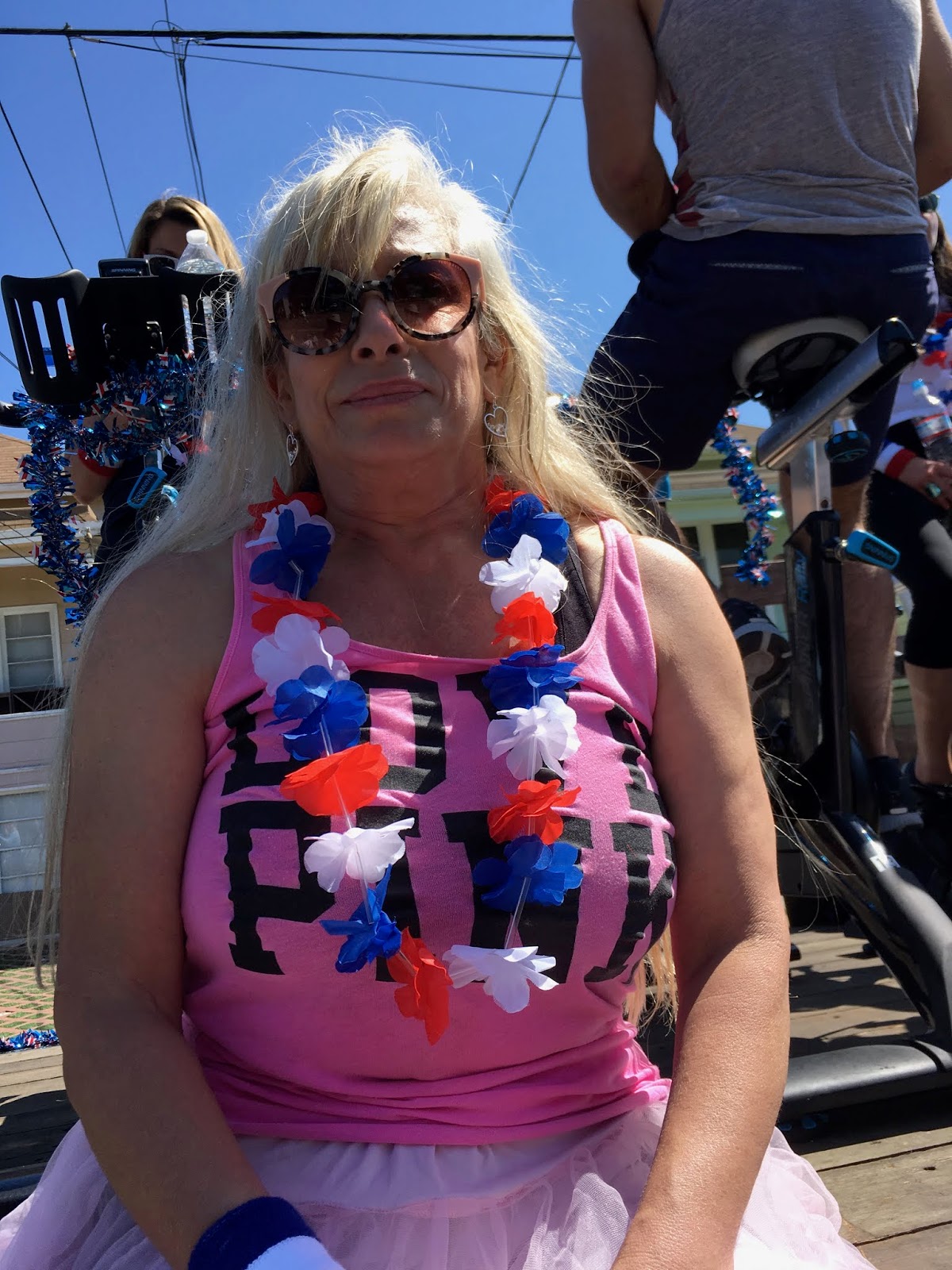
Alison: "I work out 15 minutes  day
at the stationarybicycle salon."
Rythmix Cultural Works


The US Coast Guard
Live Oak Unitarian Church


Temple Israel


Veronica, Alameda Community Radio, KACR 96.1.
On the air for two years, 24 
× 7, financed by donations


Wednesday, April 3, 2019

Who are the Homeless?

from Pictures of a Gone City by Richard A. Walker
    John Donne's Meditation XVII makes his case for us all being in this together.  "No man is an island entire of itself," he wrote, and "any man's death diminishes me,/because I am involved in mankind."  Alameda's special election April 9 will show whether the "Island City" thinks Donne's words apply to us, despite our surrounding waters.

    The issues on the ballot are to approve Measure A, which creates a Wellness Center providing services to the poor and elderly; or B, which precludes the center out of concern that the homeless would swarm across the drawbridges and overwhelm our little island, if word gets out that we're a place where they can get warm and dry.  The only cause for homelessness that many B supporters acknowledge is substance abuse, which makes them people to avoid.  But in my experience there's another factor to consider: higher education.

    Last November I learned that one of the students in the Computer Science class I teach at San Francisco State was living in his car.  For study time, he relies on the library staying open 24 × 7.  He's far from being the worse off; other stake out spots under the luxurious campus shrubbery.  And SF State is no outlier in California. According to Michael Greenberg in his 1/17/19 essay in the New York Review of Books called "California in Crisis," a UC Irvine professor estimates that fully 10% of his students live in their cars.

    How many of those who lost their homes say it was because of money issues, such as college students who can't afford their education?  58% according to Richard A. Walker, Professor Emeritus of Geography at UC Berkeley, in his 2018 book about the SF Bay Area called Pictures of a Gone City.  Mental health issues are in 2nd place at 14%, substance abuse in 5th at 10%.  48% would not be homeless if they had rent assistance.

    The subtitle of Walker's book is Tech and the Dark Side of Prosperity in the San Francisco Bay Area, and it's about life in a megalopolis where worlds collide: we have the highest density of billionaires on the planet, and a level of inequality on a par with Guatemala.  The collision is especially violent when it comes to housing.  As throughout California, the effect of property tax laws and zoning restrictions is to maximize home prices.  Great if you have a mortgage you can afford, not so hot if you're forced out to live in your car or on the streets.

    But it must be acknowledged that some of the homeless really are mentally ill substance abusers, and seeing someone on the sidewalk shooting up, or arguing with his demons, is a glimpse into a deep circle of hell. But if the goal is to minimize public expenditures, remember that we all ready pay an exorbitant price for the homeless services provided by courts, jails, prisons, the police, and hospital emergency rooms. From harrowing first hand experience, I can tell you that an addict could be in out of county jail 5 times a year, with attendant court hearings and police encounters.  My guesstimate is that the cost was more than an average Bay Area mortgage.

    The Wellness Center would have been far cheaper, but those costs would be borne by everyone, while the benefit of making the homeless invisible in Alameda would flow to property owners.  But even assuming Alameda's goal is simply to maximize housing prices, refusing services to the homeless may not be good policy.  The problem is that it's a popular approach throughout the Bay Area, and our region is quite a reputation for being heartless.  Which isn't good for real-estate prices either.  Who wants to live in the land of the selfish creeps?  There's always the risk that your daughter may come home from high school after encountering John Donne, and start giving you searching looks.


MEDITATION XVII

by John Donne

No man is an island entire of itself; every man 
is a piece of the continent, a part of the main; 
if a clod be washed away by the sea, Europe 
is the less, as well as if a promontory were, as 
well as any manner of thy friends or of thine 
own were; any man's death diminishes me, 
because I am involved in mankind. 
And therefore never send to know for whom 
the bell tolls; it tolls for thee. 

Sunday, February 10, 2019

A Pity Beyond All Telling

About homelessness, in life and in the media.  The title is misappropriated from The Pity of Love by W.B. Yeats: A pity beyond all telling/is hid in the heart of love… .   I'm not sorry.  ≈1.9K words, © ยต 2019

    My younger son Sam had come over for a leisurely weekend breakfast, along with my friend Chuck, visiting from Chicago.  We were talking about the Tenderloin. Every week Sam works his 40 hours at an equipment rental place; and he goes to a couple of AA meetings; and he volunteers to teach a class in anger management at the sober house he used to live at.  So it's a big deal for him to use precious weekend time to drive to the Bay Area from his home near Turlock. He has fundamentalist American food tastes, but tolerates my effrontery in serving him coffee with soy milk, fried potatoes without ketchup.  As he has adapted to my habit of injecting "serious" discussions into innocent social occasions.  That morning, I told them about a podcast that included a Russian journalist's impressions of the seamy side of the Bay Area. Then Sam told us a little story from his own time living on the streets.

    When Sam was in the Tenderloin, he would scavenge clothes from refuse bins, and then try to sell them on the streets to people who'd assume that they'd been stolen.  And he kept an eye out for other hustles.  There was one guy on the streets the others were afraid of, the alpha male of the street people.  Someone told Sam that tucked away in a nook in an alley, the alpha and his girlfriend kept a shopping cart filled with precious items.  They stole the cart, and discovered that the only things in it were credit cards.  Sam assumed the cards had already been reported as stolen, and went off in search of other opportunities. But his accomplice was identified, and the next time Sam saw him he was lying in the streets, bruised and bloodied.  Nobody suspected Sam, who, as he puts it, was just some "random tweaker."

    I told him he should write that story down.  And the one about getting beat up when he was in jail for the last time.  Alas, there's only 24 hours in his days too.  But some day, I believe he'll write the homeless the way the tale should be told, a story that gets in your face and follows your around.  For now, here's my version: my son could have died of exposure on the streets while people walked past him without comprehending, seeing nothing.
    
    P.S. Here's a whirlwind tour of media depictions of the homeless, as gleaned from my lower rung of the ivory tower.


……  ……  ……  ……  ……  ……  ……  ……  ……

    If you don't know the Bay Area, the Tenderloin is a district in downtown San Francisco with two museums, a Nordstrom store, a Hilton hotel at Union Square, and blocks that respectable natives know to avoid.  That's just part of our urban survival instincts, like how we won't notice homeless encampments near busy thoroughfares.  But it's a magnet for runaways, and addicts of all ages who have burnt their bridges by preying on family and friends.  Alexey Kovalev checked into the Union Square Hilton as part of a bevy of foreign journalists on a nine-week tour of American newsrooms, thanks to World Press Institute fellowships. The desk clerk told them it was best not to venture a few blocks south.

    Of course as a journalist that's the first place Kovalev went.  He described what he saw on the Sean's Russia Blog (SRB) podcast, sponsored by the University of Pittsburgh's Center for Russian, East European & Eurasian Studies. (The San Francisco segment starts at 25:30 and continues for 8 minutes.)  People on the sidewalk shooting up, sniffing white powder, rambling and cursing incoherently.  A woman earning her next fix by selling lipsticks that looked like they'd been shoplifted from the nearest Walgreen. People "beyond any help."  An American colleague in New York had told him "Be prepared, San Francisco has a homeless problem, but that doesn't even begin to describe it."  But Kovalev wasn't prepared, you could still hear the shock and wonder in his voice.

    Kovalev had lived through the '90s in Moscow, and witnessed dizzying contrasts in wealth.  But somehow the sight of Teslas whizzing by people begging in the street felt different.  The journalists on the tour came from all over the world, including Delhi in India, "one of the most polluted, over-populated cities on the planet." Yet by consensus, they agreed that the misery they saw in the Tenderloin was something new and very intense.  Kovalev came to agree with his American colleague that homeless is a misnomer. Homeless implies that you could solve the problem by providing a place to live, but these are people seemingly beyond help.  That same New York colleague had also warned Kovalev that we natives were all in denial about the problem, whatever you want to call it.  Kovalev puts it in the same category as mass school shootings, or the California wildfires: problems we do acknowledge, but which conflicting interests render impossible to solve.

    You may be wondering if this Kovalev guy is a Kremlin agent, trying to sow discord?  Unlikely.  In his home country Kovalev specializes in exposing official propaganda in the Russian media.  On the podcast, he makes many flattering comparisons between the situations of American and Russian journalism: he particularly likes our First Amendment rights, the orderliness and punctual habits our newsrooms, our tax deduction for charitable contributions that secures a financial basis for independent journalism.  And he had many flattering things to say about America.  His favorite place was a tie between he Minneapolis, which fully lived up to its "Minnesota Nice" reputation, and Austin, "just a really cool place." Runner-up, Chicago; he was appropriately edified by the architecture tour of the Chicago River. So in my opinion, the words he uses to introduce his San Francisco experience are sincere: "Seriously, that place is a mess."


……  ……  ……  ……  ……  ……  ……  ……  ……

    For the homeless experience in fiction, you could do worse than Victor Lodato's short story Herman Melville, Volume I, which he read recently on the New Yorker Writer's Voice podcast.  The story takes its title from one of the books the protagonist's boy friend/traveling companion lugs around in his backpack. Both are refugees from imploded families, she fleeing her father's suicide, he escaping blows that deafened one ear. It's good for describing how different kinds of people prey on the homeless for sex, and how the homeless prey on each other to survive. And for the physical details that shape daily life, like brushing your teeth with your tongue.


……  ……  ……  ……  ……  ……  ……  ……  ……

    Richard Walker's Pictures of a Gone City puts the "homeless" problem, let's just call it that, in a Bay Area context.  He did a virtual book tour show on Doug Henwood's Behind the News podcast on 5/24/18.  Walker is a Professor Emeritus of Geography at U.C. Berkeley, specializing in California.  The subtitle of his book is "Tech and the Dark Side of Prosperity in the San Francisco Bay Area," and it's revealing in both departments.  Walker says the Bay Area, considered as a single metropolis, has arrived: we're one of the world's "superstar cities."  We are the epicenter for tech innovation, and the gusher of tech wealth has generated "more billionaires per square foot that anywhere else on the planet, with the possible exception of Hong Kong."  And we have a great climate, an open, experimental culture, and …we are  one of the most unequal places on earth, on a par with Guatemala according to the Gini index.

    Inequality plays out in housing.  The less fortunate are pushed out to the exurbs, and have slow, expensive commutes by car or on decrepit public transit.  It's no picnic even for those who luck out and live closer in.  Last semester I was a regular on a BART rush hour train from Oakland to San Francisco, and I can assure you it's uncomfortable.  And on the lowest rung of housing hell, "…the numbers of homeless are staggering. Official estimates taken one day a year run about 7,500 in San Francisco, 7,000 in Silicon Valley, and 5,500 in Alameda County."

    Figure 3.12 in Gone City is a chart showing the causes of homelessness in Alameda County, contrasting with the picture sketched by Vokalev.  Addicts are the most shockingly visible of the homeless, but according to the survey, only 31% of the homeless have drug issues, and only 25% might still have homes if they had access to mental health services.  On the other hand, 48% would not be homeless if they had rent assistance, as would another 36% if they had employment assistance.

    BTW, Gone City takes its title from the Lawrence Ferlinghetti poem Pictures of the Gone World 11, which you might call a love poem to a beautiful, but flawed and transient existence.  The last stanza starts with these lines:


 Yes the world is the best place of all
                                  for a lot of such things as 
         making the fun scene
                        and making the love scene 
and making the sad scene
                and singing low songs and having inspirations 
     and walking around
                     looking at everything

and ends with these:

Yes 
  but then right in the middle of it
                                comes the smiling

                            mortician

……  ……  ……  ……  ……  ……  ……  ……  ……

https://www.nybooks.com/articles/2019/01/17/california-the-state-of-resistance/

    And finally, Michael Greenberg has an essay in the 1/17/19 New York Review of Books  called California: The State of Resistance, which puts the homeless in a state-wide and national context.  For those who think of California as leading the blue state resistance to Trump, you could say that Greenberg plays the role of Ferlinghetti's "smiling mortician."

    True, we are not cooperating with scapegoating the undocumented, and "California has strengthened its carbon emissions laws in response to the EPA’s rollback of the Clean Air Act, fuel efficiency standards, and other environmental regulations." On the other hand, if you think California will point the way to closing the yawning gap between rich and poor, the chasm that formed the backdrop to Trumps election — think again. "More than a quarter of the nation’s homeless live in California." (with only about 12% of the population).  Thanks largely to Prop 13 and NIMBYism, the median home price is 597k, affordable by only 1 out of 4 residents. Obviously, one cause of homelessness is simply high housing costs.  They also cause our state to have the highest poverty rate in the country.

    How does housing insecurity play out for people who are not-so-invisible, people we can imagine going through daily lives much like ours?  Greenberg has this to say about life in the vicinity of the Magic Kingdom:
    
In Orange County rundown motels on the edges of cities and towns are crowded with working families paying week to week for their rooms. Disneyland in Anaheim is the largest employer in Orange County, with 30,000 “cast members,” as its hair stylists, costumers, custodians, puppeteers, candy makers, ticket takers, security guards, and hotel and food service workers are called. A recent survey of Disneyland employees found that “two-thirds meet the department of agriculture’s definition of ‘food insecure’; fifty-six percent are worried about being evicted from their homes or apartments,” and 11 percent reported being homeless at some point in the last two years. This invisible homelessness—people living not on the street but without a fixed shelter or address—stretches throughout Orange County: a professor at the University of California at Irvine (UCI) told me that at least 10 percent of his students sleep in their cars.

    Don't know about 10%, but homeless and hungry students at San Francisco State have been in the news. Last semester I was stunned to learn that a student in the Computer Science class I teach was living in his car.  And surprised to be surprised.


Sunday, February 3, 2019

๐““๐“ฒ๐“ช๐“ป๐”‚ ๐“ธ๐“ฏ ๐“ช ๐“Ÿ๐“ธ๐“ญ๐“ฌ๐“ช๐“ผ๐“ฝ ๐“™๐“พ๐“ท๐“ด๐“ฒ๐“ฎ — How like a winter hath your absence been¹

    Garrison Keillor resumed his daily Writer's Almanac podcast last July 23, but I just subscribed last week, on January 30.  Not because I was debating the sexual misconduct allegations that prompted Minnesota Public Radio (MPR) to sever ties with him on 11/29/17; more on those later.  The truth is that MPR's canceling his show was like losing a good friend with no warning, with no possibility of appeal: and I coped by telling myself that over meant over. Then after the Writer's Almanac Support Group appeared on Facebook, I told myself that a few ragtag diehards were trying to resurrect a few souvenir editions.  I joined, but ignored the posts until last week, when something inspired me to look carefully at their page.  And there they were, instructions about how to subscribe in iTunes.

    The little comfortable things I depended on before were much the same, although I could hear the bite of age in GK's 76-yeard-old voice.  The theme music was still Richard Dworsky on the piano playing Ge mig en dag ("Give me one day" in Swedish). After the opening bars GK said "And here is the Writer's Almanac for Wednesday January 30.  It's the birthday of Richard Brautigan …."  GK has a knack for capturing something pity about a person in a brief quote, presenting a parade of unique souls with one thing in common: they managed to find words for important thoughts. As in "Mae West, who said 'When confronted with a choice between two evils, I pick the one I haven't tried yet.'"  As in "James Joyce, born in Dublin, who said 'The demand that I make of my reader is that he should devote his whole life to reading my works.'" For the depressed counter-cultural icon Brautigan, who died by his own hand, the quote was a short poem:
30 Cents, Two Transfers, Love

Thinking hard about you
I got on the bus
and paid 30 cents car fare
and asked the driver for two transfers
before discovering
that I was
alone.

    After the "It's the birthay of <name>" segments, and the "On this day in <year>" segments, there's a pause—one gets to know that pause well, to depend on it, like the theme music. There follows my favorite part, which GK introduces with "Here's a poem for today."  On January 30, it was the Idea of Living by Joyce Sutphen, which ended with lines that you could take as a plea, or rebuke, to Brautigan:

…You need to be breathing
in order to eat paella and

drink sangria, and making love
is quite impossible without

a body, unless you are one
of those, given – like gold –
to spin in airy thinness forever.

    How I missed this daily poetry dose! The Slowdown podcast with U.S. Poet Laureate Tracy K. Smith does have its moments, as does A Poem a Day from the Poetry Foundation. But GK has more of the poems I like best, the accessible ones, with bite.

    GK and me actually only go back to 1998.  I was introduced to Prairie Home Companion by my wife Jean, who was an ardent fan.  To her, and then to us, GK embodied the concept of "Minnesota nice," with the understanding that niceness can be lively, interesting.  In our imaginations, he agreed with us that monogamy is a racy secret two people share, that everyday heroes are the only kind of heroes there really are.  In 2007, Jean helped her mom Sylvia realize a life-long dream by escorting her on a Prairie Home Companion cruise to Norway.  On the cruise she met Chuck and Kathy Zehner from Chicago, who stepped in to help when they saw Jean had her hands full caring for her mom.  They became our good friends, sticking by us when Jean had her brain tumor.  In 2016, after much sorrow, they invited me to GK's final Chicago concert in Highland Park.

    OK, the #MeToo thing. In my opinion, GK did not behave well, although he wasn't exactly Harvey Weinstein either. He described the flirtation as "mutual," but that word doesn't fully apply when one party's job depends on the other.  And he was not candid; he originally said that the whole mess was about a pat on the back gone awry, but turns out there were a score of flirtatious texts and emails.  Then he said " I can’t justify it," but that's far from an adequate apology.  See this article in the Minneapolis Star Tribune for a detailed statement of the case against GK.

    But truthfully, there were worst parts for me than any of that. One part was confronting the fact that GK was not so happily married after all, that he had distanced himself from everyday people.  Alas, the world is under no obligation to conform to one's illusions about it.  The other was understanding that GK was guilty of one of the three great crimes an American can commit, along with being poor or fat: he had let himself get old. And was doing stupid things so he could imagine himself as a younger man.

   And also truthfully, none of those failings deterred me from binge listening after we reconnected.  I've gone back as far as early January, and found this gem on the January 11 show: "William James, who said … 'A sense of humor is common sense dancing.'"


¹Of course in Sonnet 97 it's actually "How like a winter hath MY abscence been/From thee," see https://www.poetryfoundation.org/poems/45101/sonnet-97-how-like-a-winter-hath-my-absence-been.  Hey, does my poetic license include forgiveness for creative misremembering?  Sound like a joke possibility for GK's "Professional Organization of English Majors" routine.

Fourth of July parade in Alameda, that bikable city

  City of Alameda Notables The Alameda 4th of July parade is a source and expression of civic pride. At 3.2 miles, we say the east side to w...