Wednesday, April 3, 2019

Who are the Homeless?

from Pictures of a Gone City by Richard A. Walker
    John Donne's Meditation XVII makes his case for us all being in this together.  "No man is an island entire of itself," he wrote, and "any man's death diminishes me,/because I am involved in mankind."  Alameda's special election April 9 will show whether the "Island City" thinks Donne's words apply to us, despite our surrounding waters.

    The issues on the ballot are to approve Measure A, which creates a Wellness Center providing services to the poor and elderly; or B, which precludes the center out of concern that the homeless would swarm across the drawbridges and overwhelm our little island, if word gets out that we're a place where they can get warm and dry.  The only cause for homelessness that many B supporters acknowledge is substance abuse, which makes them people to avoid.  But in my experience there's another factor to consider: higher education.

    Last November I learned that one of the students in the Computer Science class I teach at San Francisco State was living in his car.  For study time, he relies on the library staying open 24 × 7.  He's far from being the worse off; other stake out spots under the luxurious campus shrubbery.  And SF State is no outlier in California. According to Michael Greenberg in his 1/17/19 essay in the New York Review of Books called "California in Crisis," a UC Irvine professor estimates that fully 10% of his students live in their cars.

    How many of those who lost their homes say it was because of money issues, such as college students who can't afford their education?  58% according to Richard A. Walker, Professor Emeritus of Geography at UC Berkeley, in his 2018 book about the SF Bay Area called Pictures of a Gone City.  Mental health issues are in 2nd place at 14%, substance abuse in 5th at 10%.  48% would not be homeless if they had rent assistance.

    The subtitle of Walker's book is Tech and the Dark Side of Prosperity in the San Francisco Bay Area, and it's about life in a megalopolis where worlds collide: we have the highest density of billionaires on the planet, and a level of inequality on a par with Guatemala.  The collision is especially violent when it comes to housing.  As throughout California, the effect of property tax laws and zoning restrictions is to maximize home prices.  Great if you have a mortgage you can afford, not so hot if you're forced out to live in your car or on the streets.

    But it must be acknowledged that some of the homeless really are mentally ill substance abusers, and seeing someone on the sidewalk shooting up, or arguing with his demons, is a glimpse into a deep circle of hell. But if the goal is to minimize public expenditures, remember that we all ready pay an exorbitant price for the homeless services provided by courts, jails, prisons, the police, and hospital emergency rooms. From harrowing first hand experience, I can tell you that an addict could be in out of county jail 5 times a year, with attendant court hearings and police encounters.  My guesstimate is that the cost was more than an average Bay Area mortgage.

    The Wellness Center would have been far cheaper, but those costs would be borne by everyone, while the benefit of making the homeless invisible in Alameda would flow to property owners.  But even assuming Alameda's goal is simply to maximize housing prices, refusing services to the homeless may not be good policy.  The problem is that it's a popular approach throughout the Bay Area, and our region is quite a reputation for being heartless.  Which isn't good for real-estate prices either.  Who wants to live in the land of the selfish creeps?  There's always the risk that your daughter may come home from high school after encountering John Donne, and start giving you searching looks.


MEDITATION XVII

by John Donne

No man is an island entire of itself; every man 
is a piece of the continent, a part of the main; 
if a clod be washed away by the sea, Europe 
is the less, as well as if a promontory were, as 
well as any manner of thy friends or of thine 
own were; any man's death diminishes me, 
because I am involved in mankind. 
And therefore never send to know for whom 
the bell tolls; it tolls for thee. 

Sunday, February 10, 2019

A Pity Beyond All Telling

About homelessness, in life and in the media.  The title is misappropriated from The Pity of Love by W.B. Yeats: A pity beyond all telling/is hid in the heart of love… .   I'm not sorry.  ≈1.9K words, © ยต 2019

    My younger son Sam had come over for a leisurely weekend breakfast, along with my friend Chuck, visiting from Chicago.  We were talking about the Tenderloin. Every week Sam works his 40 hours at an equipment rental place; and he goes to a couple of AA meetings; and he volunteers to teach a class in anger management at the sober house he used to live at.  So it's a big deal for him to use precious weekend time to drive to the Bay Area from his home near Turlock. He has fundamentalist American food tastes, but tolerates my effrontery in serving him coffee with soy milk, fried potatoes without ketchup.  As he has adapted to my habit of injecting "serious" discussions into innocent social occasions.  That morning, I told them about a podcast that included a Russian journalist's impressions of the seamy side of the Bay Area. Then Sam told us a little story from his own time living on the streets.

    When Sam was in the Tenderloin, he would scavenge clothes from refuse bins, and then try to sell them on the streets to people who'd assume that they'd been stolen.  And he kept an eye out for other hustles.  There was one guy on the streets the others were afraid of, the alpha male of the street people.  Someone told Sam that tucked away in a nook in an alley, the alpha and his girlfriend kept a shopping cart filled with precious items.  They stole the cart, and discovered that the only things in it were credit cards.  Sam assumed the cards had already been reported as stolen, and went off in search of other opportunities. But his accomplice was identified, and the next time Sam saw him he was lying in the streets, bruised and bloodied.  Nobody suspected Sam, who, as he puts it, was just some "random tweaker."

    I told him he should write that story down.  And the one about getting beat up when he was in jail for the last time.  Alas, there's only 24 hours in his days too.  But some day, I believe he'll write the homeless the way the tale should be told, a story that gets in your face and follows your around.  For now, here's my version: my son could have died of exposure on the streets while people walked past him without comprehending, seeing nothing.
    
    P.S. Here's a whirlwind tour of media depictions of the homeless, as gleaned from my lower rung of the ivory tower.


……  ……  ……  ……  ……  ……  ……  ……  ……

    If you don't know the Bay Area, the Tenderloin is a district in downtown San Francisco with two museums, a Nordstrom store, a Hilton hotel at Union Square, and blocks that respectable natives know to avoid.  That's just part of our urban survival instincts, like how we won't notice homeless encampments near busy thoroughfares.  But it's a magnet for runaways, and addicts of all ages who have burnt their bridges by preying on family and friends.  Alexey Kovalev checked into the Union Square Hilton as part of a bevy of foreign journalists on a nine-week tour of American newsrooms, thanks to World Press Institute fellowships. The desk clerk told them it was best not to venture a few blocks south.

    Of course as a journalist that's the first place Kovalev went.  He described what he saw on the Sean's Russia Blog (SRB) podcast, sponsored by the University of Pittsburgh's Center for Russian, East European & Eurasian Studies. (The San Francisco segment starts at 25:30 and continues for 8 minutes.)  People on the sidewalk shooting up, sniffing white powder, rambling and cursing incoherently.  A woman earning her next fix by selling lipsticks that looked like they'd been shoplifted from the nearest Walgreen. People "beyond any help."  An American colleague in New York had told him "Be prepared, San Francisco has a homeless problem, but that doesn't even begin to describe it."  But Kovalev wasn't prepared, you could still hear the shock and wonder in his voice.

    Kovalev had lived through the '90s in Moscow, and witnessed dizzying contrasts in wealth.  But somehow the sight of Teslas whizzing by people begging in the street felt different.  The journalists on the tour came from all over the world, including Delhi in India, "one of the most polluted, over-populated cities on the planet." Yet by consensus, they agreed that the misery they saw in the Tenderloin was something new and very intense.  Kovalev came to agree with his American colleague that homeless is a misnomer. Homeless implies that you could solve the problem by providing a place to live, but these are people seemingly beyond help.  That same New York colleague had also warned Kovalev that we natives were all in denial about the problem, whatever you want to call it.  Kovalev puts it in the same category as mass school shootings, or the California wildfires: problems we do acknowledge, but which conflicting interests render impossible to solve.

    You may be wondering if this Kovalev guy is a Kremlin agent, trying to sow discord?  Unlikely.  In his home country Kovalev specializes in exposing official propaganda in the Russian media.  On the podcast, he makes many flattering comparisons between the situations of American and Russian journalism: he particularly likes our First Amendment rights, the orderliness and punctual habits our newsrooms, our tax deduction for charitable contributions that secures a financial basis for independent journalism.  And he had many flattering things to say about America.  His favorite place was a tie between he Minneapolis, which fully lived up to its "Minnesota Nice" reputation, and Austin, "just a really cool place." Runner-up, Chicago; he was appropriately edified by the architecture tour of the Chicago River. So in my opinion, the words he uses to introduce his San Francisco experience are sincere: "Seriously, that place is a mess."


……  ……  ……  ……  ……  ……  ……  ……  ……

    For the homeless experience in fiction, you could do worse than Victor Lodato's short story Herman Melville, Volume I, which he read recently on the New Yorker Writer's Voice podcast.  The story takes its title from one of the books the protagonist's boy friend/traveling companion lugs around in his backpack. Both are refugees from imploded families, she fleeing her father's suicide, he escaping blows that deafened one ear. It's good for describing how different kinds of people prey on the homeless for sex, and how the homeless prey on each other to survive. And for the physical details that shape daily life, like brushing your teeth with your tongue.


……  ……  ……  ……  ……  ……  ……  ……  ……

    Richard Walker's Pictures of a Gone City puts the "homeless" problem, let's just call it that, in a Bay Area context.  He did a virtual book tour show on Doug Henwood's Behind the News podcast on 5/24/18.  Walker is a Professor Emeritus of Geography at U.C. Berkeley, specializing in California.  The subtitle of his book is "Tech and the Dark Side of Prosperity in the San Francisco Bay Area," and it's revealing in both departments.  Walker says the Bay Area, considered as a single metropolis, has arrived: we're one of the world's "superstar cities."  We are the epicenter for tech innovation, and the gusher of tech wealth has generated "more billionaires per square foot that anywhere else on the planet, with the possible exception of Hong Kong."  And we have a great climate, an open, experimental culture, and …we are  one of the most unequal places on earth, on a par with Guatemala according to the Gini index.

    Inequality plays out in housing.  The less fortunate are pushed out to the exurbs, and have slow, expensive commutes by car or on decrepit public transit.  It's no picnic even for those who luck out and live closer in.  Last semester I was a regular on a BART rush hour train from Oakland to San Francisco, and I can assure you it's uncomfortable.  And on the lowest rung of housing hell, "…the numbers of homeless are staggering. Official estimates taken one day a year run about 7,500 in San Francisco, 7,000 in Silicon Valley, and 5,500 in Alameda County."

    Figure 3.12 in Gone City is a chart showing the causes of homelessness in Alameda County, contrasting with the picture sketched by Vokalev.  Addicts are the most shockingly visible of the homeless, but according to the survey, only 31% of the homeless have drug issues, and only 25% might still have homes if they had access to mental health services.  On the other hand, 48% would not be homeless if they had rent assistance, as would another 36% if they had employment assistance.

    BTW, Gone City takes its title from the Lawrence Ferlinghetti poem Pictures of the Gone World 11, which you might call a love poem to a beautiful, but flawed and transient existence.  The last stanza starts with these lines:


 Yes the world is the best place of all
                                  for a lot of such things as 
         making the fun scene
                        and making the love scene 
and making the sad scene
                and singing low songs and having inspirations 
     and walking around
                     looking at everything

and ends with these:

Yes 
  but then right in the middle of it
                                comes the smiling

                            mortician

……  ……  ……  ……  ……  ……  ……  ……  ……

https://www.nybooks.com/articles/2019/01/17/california-the-state-of-resistance/

    And finally, Michael Greenberg has an essay in the 1/17/19 New York Review of Books  called California: The State of Resistance, which puts the homeless in a state-wide and national context.  For those who think of California as leading the blue state resistance to Trump, you could say that Greenberg plays the role of Ferlinghetti's "smiling mortician."

    True, we are not cooperating with scapegoating the undocumented, and "California has strengthened its carbon emissions laws in response to the EPA’s rollback of the Clean Air Act, fuel efficiency standards, and other environmental regulations." On the other hand, if you think California will point the way to closing the yawning gap between rich and poor, the chasm that formed the backdrop to Trumps election — think again. "More than a quarter of the nation’s homeless live in California." (with only about 12% of the population).  Thanks largely to Prop 13 and NIMBYism, the median home price is 597k, affordable by only 1 out of 4 residents. Obviously, one cause of homelessness is simply high housing costs.  They also cause our state to have the highest poverty rate in the country.

    How does housing insecurity play out for people who are not-so-invisible, people we can imagine going through daily lives much like ours?  Greenberg has this to say about life in the vicinity of the Magic Kingdom:
    
In Orange County rundown motels on the edges of cities and towns are crowded with working families paying week to week for their rooms. Disneyland in Anaheim is the largest employer in Orange County, with 30,000 “cast members,” as its hair stylists, costumers, custodians, puppeteers, candy makers, ticket takers, security guards, and hotel and food service workers are called. A recent survey of Disneyland employees found that “two-thirds meet the department of agriculture’s definition of ‘food insecure’; fifty-six percent are worried about being evicted from their homes or apartments,” and 11 percent reported being homeless at some point in the last two years. This invisible homelessness—people living not on the street but without a fixed shelter or address—stretches throughout Orange County: a professor at the University of California at Irvine (UCI) told me that at least 10 percent of his students sleep in their cars.

    Don't know about 10%, but homeless and hungry students at San Francisco State have been in the news. Last semester I was stunned to learn that a student in the Computer Science class I teach was living in his car.  And surprised to be surprised.


Sunday, February 3, 2019

๐““๐“ฒ๐“ช๐“ป๐”‚ ๐“ธ๐“ฏ ๐“ช ๐“Ÿ๐“ธ๐“ญ๐“ฌ๐“ช๐“ผ๐“ฝ ๐“™๐“พ๐“ท๐“ด๐“ฒ๐“ฎ — How like a winter hath your absence been¹

    Garrison Keillor resumed his daily Writer's Almanac podcast last July 23, but I just subscribed last week, on January 30.  Not because I was debating the sexual misconduct allegations that prompted Minnesota Public Radio (MPR) to sever ties with him on 11/29/17; more on those later.  The truth is that MPR's canceling his show was like losing a good friend with no warning, with no possibility of appeal: and I coped by telling myself that over meant over. Then after the Writer's Almanac Support Group appeared on Facebook, I told myself that a few ragtag diehards were trying to resurrect a few souvenir editions.  I joined, but ignored the posts until last week, when something inspired me to look carefully at their page.  And there they were, instructions about how to subscribe in iTunes.

    The little comfortable things I depended on before were much the same, although I could hear the bite of age in GK's 76-yeard-old voice.  The theme music was still Richard Dworsky on the piano playing Ge mig en dag ("Give me one day" in Swedish). After the opening bars GK said "And here is the Writer's Almanac for Wednesday January 30.  It's the birthday of Richard Brautigan …."  GK has a knack for capturing something pity about a person in a brief quote, presenting a parade of unique souls with one thing in common: they managed to find words for important thoughts. As in "Mae West, who said 'When confronted with a choice between two evils, I pick the one I haven't tried yet.'"  As in "James Joyce, born in Dublin, who said 'The demand that I make of my reader is that he should devote his whole life to reading my works.'" For the depressed counter-cultural icon Brautigan, who died by his own hand, the quote was a short poem:
30 Cents, Two Transfers, Love

Thinking hard about you
I got on the bus
and paid 30 cents car fare
and asked the driver for two transfers
before discovering
that I was
alone.

    After the "It's the birthay of <name>" segments, and the "On this day in <year>" segments, there's a pause—one gets to know that pause well, to depend on it, like the theme music. There follows my favorite part, which GK introduces with "Here's a poem for today."  On January 30, it was the Idea of Living by Joyce Sutphen, which ended with lines that you could take as a plea, or rebuke, to Brautigan:

…You need to be breathing
in order to eat paella and

drink sangria, and making love
is quite impossible without

a body, unless you are one
of those, given – like gold –
to spin in airy thinness forever.

    How I missed this daily poetry dose! The Slowdown podcast with U.S. Poet Laureate Tracy K. Smith does have its moments, as does A Poem a Day from the Poetry Foundation. But GK has more of the poems I like best, the accessible ones, with bite.

    GK and me actually only go back to 1998.  I was introduced to Prairie Home Companion by my wife Jean, who was an ardent fan.  To her, and then to us, GK embodied the concept of "Minnesota nice," with the understanding that niceness can be lively, interesting.  In our imaginations, he agreed with us that monogamy is a racy secret two people share, that everyday heroes are the only kind of heroes there really are.  In 2007, Jean helped her mom Sylvia realize a life-long dream by escorting her on a Prairie Home Companion cruise to Norway.  On the cruise she met Chuck and Kathy Zehner from Chicago, who stepped in to help when they saw Jean had her hands full caring for her mom.  They became our good friends, sticking by us when Jean had her brain tumor.  In 2016, after much sorrow, they invited me to GK's final Chicago concert in Highland Park.

    OK, the #MeToo thing. In my opinion, GK did not behave well, although he wasn't exactly Harvey Weinstein either. He described the flirtation as "mutual," but that word doesn't fully apply when one party's job depends on the other.  And he was not candid; he originally said that the whole mess was about a pat on the back gone awry, but turns out there were a score of flirtatious texts and emails.  Then he said " I can’t justify it," but that's far from an adequate apology.  See this article in the Minneapolis Star Tribune for a detailed statement of the case against GK.

    But truthfully, there were worst parts for me than any of that. One part was confronting the fact that GK was not so happily married after all, that he had distanced himself from everyday people.  Alas, the world is under no obligation to conform to one's illusions about it.  The other was understanding that GK was guilty of one of the three great crimes an American can commit, along with being poor or fat: he had let himself get old. And was doing stupid things so he could imagine himself as a younger man.

   And also truthfully, none of those failings deterred me from binge listening after we reconnected.  I've gone back as far as early January, and found this gem on the January 11 show: "William James, who said … 'A sense of humor is common sense dancing.'"


¹Of course in Sonnet 97 it's actually "How like a winter hath MY abscence been/From thee," see https://www.poetryfoundation.org/poems/45101/sonnet-97-how-like-a-winter-hath-my-absence-been.  Hey, does my poetic license include forgiveness for creative misremembering?  Sound like a joke possibility for GK's "Professional Organization of English Majors" routine.

Saturday, February 2, 2019

Garrison Keillor's last Chicago Show (originally posted Aug. 2016)

§
The Show Must Go On

    Garrison Keillor has tried retiring before, but it's different this time.  He's picked out his successor, Chris Thile, a MacArthur genius award-winning mandolin player, who will steer Prairie Home Companion (PHC) in the direction of less talk/more music.  There's nothing wrong with that mix now, but Garrison's talk is irreplaceable. When Chris was asked if he might rescind his retirement decision again, Chris laughed and said "unlikely."

    For good reason.  On June 3rd, Garrison had a brain seizure after doing two back-to-back concerts in Virginia.  After an an MRI at the Mayo clinic, he issued a press release saying the brain scan showed a dark area near, but not in, the language area of his brain.  And that he intended to finish his last tour anyway.

    What do you take from that, you with experience decrypting medical bulletins from family and friends?  Reassurance? A note of defiance?  No and Yes for me.
Chuck and Kathy, 2016

    Early February, when my friends Chuck and Kathy had invited me to visit them and go to Garrison's last live Chicago performance, was a high point of this electoral season.  The three of us are ardent Sanders supporters, and expected him to do well in New Hampshire. And the previous week, when Sarah Palin endorsed Donald Trump, the NY Daily News had published its famed "I'm with Stupid" front page, with the photo of Palin and Trump pointing to each other approvingly.  But by June, Don had vanquished his Republican rivals, and the Hillary machine had amassed enough delegates to secure the Democratic nomination.  As Yeats said, and Garrison read, when he selected The Second Coming as the poem on on his Writer's Almanac podcast: The best lack all conviction, while the worst/are full of passionate intensity.  In my febrile imagination, Garrison's saw his last tour as a chance to rally the blue state tribe.


§
The Lewis Family Home Companion

    My first impulse was to tell Chuck and Kathy no thanks.  I'm teaching a summer session Computer Science class at SFSU, and needed to spend that weekend writing lesson plans.  In other words, I'm a grind.  But I ended up saying yes, thinking that Jean would have liked the idea of closing the circle.

    In August 2007, Jean accompanied her mom Sylvia on a PHC cruise to Norway.  Sylvia, then 86, purchased two tickets well in advance, hoping to persuade her boyfriend Ben, a trombonist whom she'd met at a jam, to use the other. But after Ben died suddenly of a heart attack that April, Sylvia started losing her bearings.  She did remember her tickets however, and asked Jean to go in Ben's place.  Jean wanted her mom to have one more adventure, and she'd been a PHC fan herself since her college days U. of M. Fortunately, on their very first day on the ship, they met Chuck and Kathy.

    By that time, Sylvia was incontinent.  Chuck and Kathy saw the situation, and stepped in to help without being asked.  Sylvia also needed constant attention to prevent her from wandering off, and her new friends would keep an eye on her so Jean could dash off on lightening tours at Norwegian ports of call.

    At this point in the story, Garrison might step in and dead-pan something like "it was a struggle, but they kept Sylvia clean and dry."  And they did.  And mother and daughter also performed an accordion/flute duet in the cruise talent show, exchanging a few words with Garrison himself during the festivities.  Sylvia confused was still a commanding presence, and on the flight back to Detroit she decided they were disaster victims, and demanded that Jean lodge a complaint with the Red Cross about their cramped facilities.  Jean calmed her down, and got her home safely to Ann Arbor.

    Our own favorite PHC show gave us a shorthand for saying we're deeply married, "burying the pigs."  It was 2001, summer was ending, and Jean and I were walking on the beach at Alameda at sunset, holding hands, listening over headphones.  That April Jean had a miscarriage, convincing us to end three years of escalating fertility treatments that started with hormone injections and culminated in fetal implants.  The very next week, my manager handed me a cardboard box and said to clear out my cubicle. In May 2000, I'd left BofA, where I'd been a software engineer for fifteen years, looking forward to a job doing more actual computer programming.  By August 2001 I'd been unemployed 4 months, no interviews scheduled, and my child support payments were higher than my unemployment benefits.  Instead of bearing our own child, Jean was supporting two we never saw, and me.

    The Lake Woebegone monologue was about a rural couple who plough their savings into a pig farm.  Things go well, until an infection sweeps through the drove, killing all the pigs.  What would they do?  Plenty, in the fullness of time, but something was required immediately.  They didn't blame each other for the stupid mess they were in, they just worked together digging a burial trench.


§
The Show

    The show was actually in Highland Park, a verdant suburb 25 miles north of Chicago, at the Ravinia Pavilion, June 11.  At the entrance, gulping the hot coffee not allowed inside, I noticed a t-shirt promoting the Ricky Byrdsong Race against Hate. Asked, and learned that Ricky had been an African-American basketball coach at Northwestern, gunned down in 1999 by a neo-Nazi on a killing spree that also netted him an Asian-American and an orthodox Jew.  The shirt seemed to resonate with the political moment, although my memory could be clouded by the Orlando massacre, which happened about 10 hours later.

    Garrison wore an off-white suit and a red tie.  His tall frame is a little bowed, 
Before the Broadcast
hair graying, face aged, and when he sits down between the segments when he must stand to speak and sing into the mike, he does so slowly and carefully.  The backdrop of the stage was decorated with signs for "sponsors" familiar to PHC listeners: Powdermilk Biscuits, the American Duct Tape Council, Cafรฉ Boeuf. Before the broadcast began, he and guest star Heather Masse (she of the Wailin' Jennys) strolled from the stage down the center aisle and out into the surrounding park, where people listened to the show over loudspeakers.  They sang a medley of patriotic songs, including America the Beautiful and The Battle Hymn of the Republic.  When they came back in we all stood for The Star Spangled Banner.

    The show proper began with his tribute song/monologue to the Windy City, cued by notes on sheets of 8 1/2 × 11 paper that he let fall to the floor as he finished them.  The tribute is a series of swift images and maxims that portray a "blue collar city."  Don't wear a tie or ask for artisan beer.  Architecture is the 
Heather and Garrison
natives' favorite art form.  "Sign saying 'get a new life through bankruptcy'." "Women in pink hair and pink slippers."  Sign for St. Helen's: "'What's missing in CH _ _ CH?  UR!'"  Corner grocery store selling pickled eggs and fresh baked rye bread, the cashier so busy arguing in a "foreign tongue" with another woman, who could be her mom, that she waves aside Garrison's attempt to pay for a small item.

    It's been a quiet week in Lake Woebegone … where all the women are strong, all the men are good looking, and all the children are above average.  Unlike the tribute song, Garrison does his famous monologue entirely without notes, pacing back and forth across the stage, head down, often turning his back to the audience.  Like a boy squirming to justify his misadventures to a skeptical but convincible authority figure, coming to the point cautiously.

    Being June, the theme was graduation.  Back in the day, graduates were not congratulated, they were interrogated about summer jobs, and picking potatoes and laying asphalt were two correct answers. At the 2008 Lake W. High graduation, a teacher gave a speech in a storm, holding an umbrella over his head, "knowing he should stop but not being able to."  "They remember that graduation, but not a single word he said … an important lesson there for intellectuals."  At a recent ceremony, Lake W. High featured a speaker from Garrison's class, who lives in Florida, plays golf, and runs half marathons.  He looked old and fragile, which Garrison attributed to excessive physical activity — all the exercise you really need you can get just by sitting at a desk and writing.  But even the contemplative life wears you out eventually, and he read a limerick about the inevitable end game:

    Old age is a treacherous bridge.
    It comes to the poor and the rich.
    You get up in the night
    and then on comes the light
    and you find that you pissed in the fridge.
  
    Heather sang In a Sentimental Mood, which we were, and Chris performed a song called Da Da Da, celebrating emerging life in the guise of his one-year-old son Calvin, and Calvin's expressive single-word vocabulary.  Garrison announced the intermission, "time to see a man about a dog," and Heather, Chris, and Richard Dworksy sang Stars and Stripes Forever while the audience stirred to take care of business.

    There was more graduation irony in the second hour.  Garrison read a poem written from the perspective of unabashedly relieved parents: … No more church youth groups, amen/ and we'll never watch field hockey every again … .  Heather sang a parody of Dark as a Dungeon, the famous Merle Travis number about life in the coal mines.  Instead of Come all you young fellers so young and so fine/and seek not your fortune in a dark dreary mine, the second line in the PHC version is Get you a job doing something online. Picking potatoes and laying asphalt are not necessarily virtuous acts nowadays.
    
    At the end, Garrison noted that he had performed at Ravinia every year since 2004, and was happy to be here one last time.  The audience brought him back for an encore, and Garrison, just 73, joined in singing the Beatles' She was just Seventeen, and then took a final bow with Goodnight, Irene.


Chuck, Kathy, Marilyn, Matt
Marilyn was on the Norway cruise when
Jean met Chuck and Kathy
     We walked back to our cars, stopping briefly for group photos.  Chuck noted there had been no Guy Noir, Private Eye routine; no Dusty and Lefty, cowboys on the open range range. And the Lake Woebegone monologue had not been saved for the second hour.  Obviously all part of a gentle exit strategy.  Garrison's sign-off on his Writer's Almanac podcasts is "Be well, do good work, and keep in touch."  Wishing Garrison the same in his next phase.


§
Epilogue

    Stuart Dybek is from Chicago, but his poem The Windy City is not explicitly about his hometown. Is it?  I read it as an eulogy to the passing of youth, which ties in with Garrison's graduation them.  Which ties in with retirement.  Anyway, as Garrison might say, it's a really good poem.


Sunday, January 27, 2019

Alameda Climate Plan Citizen Input Day

    Approximately 100 islanders, including Vice-Mayor John White, and city council member Tony Daysog, gathered at Alameda High this morning to provide their input to the city's Climate Action and Resiliency Plan.  Alameda Commissioned the Eastern Research Group (ERG) to create the plan, which is slated to be completed by April.  Whether or not you were present today, you have until Feb. 8 to provide your input to ERG at https://opentownhall.com/7127.

    ERG divided us into groups, which rotated through discussions of three challenges: how to reduce Greenhouse Gas (GHG) emissions; how to prepare for Sea-level rise; and how to prepare for drought, heat waves, and wildfire smoke.  In each session we were asked for our opinions lists of possible responses.

    In the GHG reduction session, ERG presented with lists of possible approaches divided into four cost/benefit categories.  Electric vehicles (EVs) were popular in our group, with possible approaches ranging from standardized charging stations (low cost, high benefit), to incentivizing ownership with tax credits and reduced electricity rates from Alameda Power and Telecom (high cost, high benefit).  It's worth mentioning that transportation is responsible for one half of all GHG emissions in Alameda.  Adding 1,500 street trees to the "urban forest" (low cost, low benefit) was popular too.  Surprisingly, ERG placed a new BART tube in the high cost, low benefit category.  Apparently they felt that the tube would lead to more housing on the island, and no net decrease in traffic.  But I don't agree, since commuting to/from the island by bicycle is a major nuisance; and the high cost of housing, and the tragedy of the homeless, are regional disgraces.

    Participants in the sea-level rise session had a marked preference for natural solutions, such as mud flat augmentation, as opposed to more engineering heavy solutions like building sea walls.

    In my group, the favorite approach to preparing for wildfire smoke was a public awareness campaign, including informative articles on the web; but my opinion was that the best public awareness campaign would be to pass out masks the next time disaster strikes.

    One final note about transportation.  On Feb. 27, the city council will consider the Transportation Choices Plan.  I just received the .pdfs today and have not had the time to read them yet.  Please tell if you would like a copy.  More bike lanes are part of the plan, although I'm not sure if it calls for completion of the cross Alameda East-West bicycle trail.  And it would be ambitious indeed if it called for a bicycle/pedestrian bridge to Jack London square, so that bikers would not need to chose between riding through the filthy tube, or the lengthy, dangerous ride to Fruitvale BART station.  But if does appear in the report now, this could be a good time to raise the issue.

References:

This interactive map shows the effect of sea-level rise in the San Francisco Bay Area. Type in your home address, select a scenario, and see how your neighborhood will be impacted by one consequence of climate change.
https://explorer.adaptingtorisingtides.org/home

The State of California has published a 2018 edition of its Sea-Level Rise (SLR) Guidance report for the San Francisco Bay Area. Pages 19 and 20 have tables showing projected sea-level rise under conditions of low and high emission. In 2100, these will likely be 1+ ft. and 2+ ft. respectively. Of course calculating flooding risk also entails considering storm surges. 
http://www.opc.ca.gov/webmaster/ftp/pdf/agenda_items/20180314/Item3_Exhibit-A_OPC_SLR_Guidance-rd3.pdf

Tuesday, January 1, 2019

If you Build it, They will Come

Ribbon-cutting for a people sanctuary.  Mayor Trish Spencer wielding the scissors, with
Congresswoman Barbara Lee and Assemblyman Ron Bonta to her left, and Jim Sweeney to her
right holding book.  Mayor-elect Ezzy Ashcraft is behind Jim.
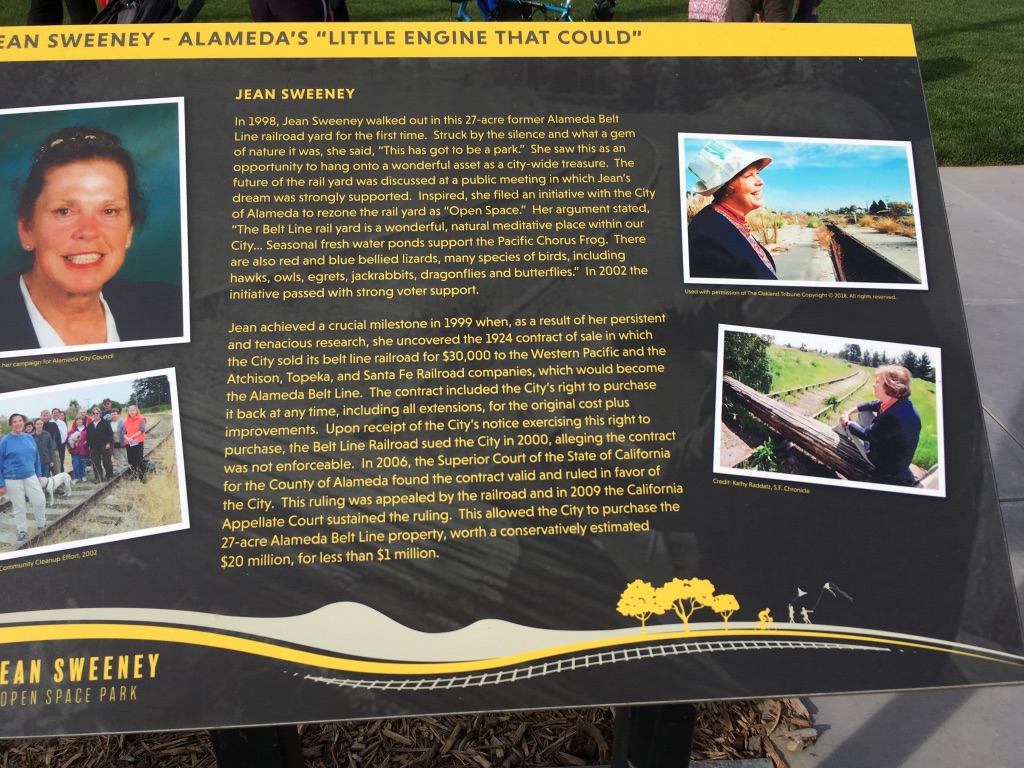
    The Bay Area has a new people sanctuary, known as the Jean Sweeney Open Space Park.  It's on the site of the old Alameda Beltway Railroad. The late Jean Sweeney is the woman who first envisioned it as a park, and then found the clause in a 1924 contract that allowed the city of Alameda to repurchase the property for the selling price.


City Attorney, wearing t-shirt
that cites SCOCA verdict
    That was in 1999.  The city ended up in court, with local legal talent facing off against a Los Angeles firm that had been representing the railroads since the old robber baron days.  But as one of our attorneys told me, that firm had no idea who they were up against.  In 2009, the California Supreme Court ruled the clause valid, upholding a Superior court decision, which in turn had reversed a trial court verdict siding with the railroad.  Then came the hard part, clearing away toxic waste, and planning and building park features.  By Saturday December 15, enough of Jean's dream had been constructed to justify a grand opening.

    Young children swarmed over lawns and slides and swings, while a couple hundred adult islanders listened to interesting speeches: not the least of the reasons why Alameda is a special place is that speakers at official events feel emboldened to talk real.
Slide 12/15/18
Slide 1/1/19


    California assemblyman Ron Bonta shared a telling anecdote about Jean Sweeney and her husband Jim.  All that happened was that he ran into them once on a deserted beach in Alameda when they were picking up litter.  Nobody else was there to approve or applaud: they were exactly the same people in private as they were were in public.  Jim Sweeney spoke too, holding up a copy of the children's book, The Little Engine that Could. Jean saw herself as the little engine, an unassuming person rising to the occasion because she believed in her vision.

    Cathy Dana, one of Alameda's poets laureate, pointed out that by saving bird habitat, we create a people sanctuary too;  a little dose of nature is vital to the well-being of city dwellers. She connected Jean's vision to the tag line of Field of Dreams,  and read her poem Ode to Open Space, with lines that captured the
12/15/18
exuberance of the young ones:  "the little girl with pink tights and purple cowboy boots/runs and twirls for the sheer joy of it."

    
    Another speaker predicted that Sweeney would become an iconic park, like Tilden in Berkeley, or Golden Gate in San Francisco. Hyperbole due to an overdose of civic pride?  After all, Tilden is 740 acres, Golden Gate 1,017; Sweeney only 22.  Even Alameda's own Shoreline Park on upscale Bay Farm Island is larger, at 32 acres, and Estuary Park, opened in 2018 on the far west end, is a respectable 8. Yet Sweeney Park does epitomize Alameda.  It's inclusive, environmentally aware, and it's a work in progress.
Rotary Club of Alameda Pavilion

     Sweeney's inclusive in part because of its location.  It's on the west side, the formerly Navy side, the more downscale, diverse side, the side that needs open space the most.  It borders four public housing project buildings, as well as the Alameda Food Bank, which feeds the hungry.  And it's also inclusive because we had to stay united during the long years of costly litigation, and because we
Legionnaires at grand opening 
celebrated the victory together and acknowledged everyone's efforts  There were a group of uniformed American Legionnaires present; we were entertained by the Oakland Gay Men's Chorus; and the old train station was restored as a gazebo, with picnic tables, and renamed the Rotary Club of Alameda Pavilion.  Make no mistake, we have the same divisions and presentments as the rest of the Bay Area, but it feels different.  We live closer to each other, not in separate worlds, as in the Oakland Hills vs. West Oakland.

Lawn in front of RC of A Pavilion, Webster Street Gazebo in background

    ReScape California certifies Sweeney Park as environmentally aware with its highest rating, Bay Friendly.  Their criteria are that the park uses appropriate, drought tolerant plants; those plants are nourished from compost made from the contents of Alameda's green bins; and the soil is protected by mulch made from local trees. But that wouldn't be enough if the park didn't attract homo
Jennifer West from Stop Waste
Saplings with Mulcj
sapiens.  The lawns are the greenest and softest in my memory, and Mexican sage and tufts of native grass express well-established local tastes in horticulture.  The play structures look imaginative to this adult, and the children give them their stamp of approval.  Jogging/bike paths wind, dip, and rise across the .6 miles/1 km length of the park, and now they're part of my morning run.  Even on drizzly December mornings, I've never seen fewer than a dozen others.  Today, New Years Day, I ran at noon, and saw well over a hundred, and the parking lot was full.


    And, it's a work in progress: much remains to be done.  A fenced-in band of empty lot runs along the south edge of the park, parallel to the paths.  The play structures, gazebo, and plantings are all on the eastern third, next to a wide swath of bare dirt that extends half the length of the park. Moreover, the bike
To completed in Sweeney v2.0
paths are part of a grand plan called the Cross Alameda Trail, which could one day traverse the island east to west.  Completing that trail, and developing the rest of the park in the Bay Friendly, people friendly way, will require ongoing commitment.  Alameda faces the same budget dilemmas as any other city in the era of stingy public finances.  But we're a work in progress too.


    Ezzy Ashcraft was elected mayor November 6, confirming our reputation as a notably progressive and green city, even for the deep blue Bay Area.  Ezzy was at the Sweeney opening, and on her first day in office, two days
Mayor Ezzy Ashcraft
later, she helped open Alameda's first warming shelter for the homeless.  She's well aware that sea-level Alameda is on the front lines of climate change impact, and thus it behooves us to set a good example of the policies needed to avert catastrophe.  Best bet: more good news for the human beings from the little city that could.


 -- © ยต 2019


Full parking lot at Sweeney Park, 1/1/19.


Monday, December 3, 2018

Bay Area Sketchbook: Strangers on a Train

Encounter on BART.  © ยต 2018,  ≈ 1.1K words

    ‟You're a selfish asshole!” the young woman said, her face a couple of feet from mine on a BART car.  She had raised her voice but probably wasn't screaming; in noisy environments, the hearing impaired can't always tell the difference.  It was 8 am and the train was packed so tightly that the standing passengers couldn't shift weight from foot to foot without brushing against someone else.  Unless they were standing near me, in which case they likely brushed against my bicycle.  It was the bicycle that had set her off.

    BART does not allow bikes on crowded cars, but such cars are the only type available on San Francisco-bound trains at the Fruitvale station during commute hours. In my experience, morning commute hours start before 6 am, and last at least 3 hours.  My sub-compliant strategy is that if I can squeeze onto the car, then I can thread my way to the so-called "bicycle area," and strap my bike to the horizontal bar.  Once in position, everyone will have barely enough room, not too much worse off than before my entry.

    But on the morning of the young woman, I pushed the envelope. I did manage to shoe-horn into a full car, but was too embarrassed to ask people to let me through to the  bike area on the other side. So there I was, stranded in the middle of the car, hanging onto a strap with one hand and holding up my bike with the other.  Uncomfortable, and so was everyone around me.  A friendly twentyish guy sporting a curly black beard, and wearing cargo shorts and a square Jewish cap, asked if he could lean against my bike.  Certainly.

    Then the young woman emerged from the mass of passengers and confronted me.  She was attractive, her white a shade paler than mine, and well-dressed and well-coiffed in a proper, corporate way. Couldn't tell at a glance whether she was more likely to be a receptionist or an executive, but clearly she was not to be trifled with.

    ‟Can't you see there's no room for you?” she asked, voice quivering with indignation.

    ‟I was hoping to get to the bike area, but there are too many people.”

    ‟Doesn't that tell you something?” she said sarcastically.  ‟You should have waited for another train!”

    ‟I'm supposed to teach a class at CCSF.”

    ‟Then wake up earlier!” she said, and that's when she called me a selfish asshole.  To little effect.  The people around us were absorbed with their phones, or pretended to be.  And somewhere along the years my capacity for anger was much diminished. 

    ‟Sorry you feel like that,” I said softly.  ‟Tell me, how did you get to BART today?”

    ‟I took the bus,” she said, not to be out greened.

    ‟Your bus had less traffic to contend with because I rode my bike.”

    Then the Jewish cap guy said something to the young woman I couldn't catch.  But if he was taking her side, wouldn't he be addressing me instead?  The young woman tried to resume her attack, but another passenger, a 50ish oriental woman with a downcast, comprehending face, leaned toward us and said something else to her that I couldn't hear.  Maybe it was "don't waste your breath talking to selfish assholes," but my antagonist looked stifled, miffed.

    I said "would it help if you knew that I pinched a nerve in my lower back, and riding a bike is the only way I can get around comfortably?" She stared past me stonily.  We'd come so far so fast: just met, and already we weren't on speaking terms.  Then the train pulled into the West Oakland station.

    The door opened behind me and a knot of would-be passengers stood there, not even attempting to enter.  No space for them, and all because of me, absolutely nobody needed to point out.  I raised my own voice to address the surrounding passengers: "If I could just get over to the bike area it would solve many problems." And wordlessly they made way for me, most without looking up from their phones; I put my bike against another that was there first; the new passengers boarded successfully; everyone actually had MORE room than they had before; there were now several people standing between me and the young woman who had denounced me. I love you, Northern California.

    Our train passed under the Bay, disgorged scores of passengers at the Embarcadero Station.  Ahhh, room.  The young woman took a seat on the opposite side of the train, and pecked at her phone disconsolately.  I opened my laptop, but couldn't concentrate on my lesson plan.

    Because I wanted to comfort her.  Hadn't she humiliated herself, wasting energy by lashing out at me, when she could have solved the problem easily by helping me get where I needed to go? Maybe she worked producing meditation tapes, and distancing herself from anger was a source of pride.  No, that was nuts, she wouldn't be feeling bad when the rulebook was clearly on her side.  She might well be texting a complaint, portraying herself as the only one on that cowed car willing to speak up against my depredations.  A crackdown on insolent two-wheeled commuters might ensue.

    Which I could prevent simply by crossing the train and apologizing for my part in our misadventure.  Then she would tell me who she was, by way of apologizing for her part.  Me, ‛terribly sorry, you were right, I miscalculated, should have waited for the next train.’  Her, ‛Where I work, a woman was fired because she tore her jeans on her way to work; so when your wheel touched my pantsuit, I lost it.’ Or maybe ‛my girlfriend left me, and I lay in bed for a week, calling in sick, thinking about suicide.  Today was my first day back, and when I saw you and your bike, it felt really great to fantasize about killing someone besides myself. Like, maybe it means I'm recovering?!’

    My turn again.  ‛In recent months, since I pinched the nerve, I've accomplished many wonderful, difficult things.  Like shopping for groceries, cleaning house; remaining standing and calm on crowded BART trains that stalled under the Bay, while half-hearing crackly announcements promising that our train would be moving again shortly.  And didn't miss a class, not one, or consciously wince in front of a student.  Do I not deserve a medal, the coveted Seniors' Prize for Keepin' Goin'?’

    Satisfied with my world again, I focused on my lesson plan.  The young woman was gone when I looked up again at Balboa Park Station.

-  ยต   2018

Las Lomas High class of 1968 in June 2026

   Pinky's Pizza and  Pub Walnut Creek, Friday 6/5/26 Ro w 1   Mark Fambrini, Bill Wyman; Debbie Gunn, Susan Schrader, Carol Mitchell; C...