Wednesday, July 4, 2018

Little Thing


Clark, April 17 2108
    Providence Vet sent me a sympathy card, with wildflower seeds to plant in Clark's memory.  Flowers are a fitting memorial. Clark loved to hang out in the garden, and would crouch by the back door, waiting patiently for me to notice and let him out.  He used his squeaky meow sparingly, mainly to tell me it was dinner time; a loud, urgent meow, accompanied by a light paw swipe to the arm, was his Cat for saying "that hurts!" 
Clark in hopsital
As when a flea comb encountered a fresh wound while brushing out his coat.  But he forgave me my trespasses.  If it had been a hard day I'd mention that to him — are there really people who don't talk to their cats? — and he seemed to understand, would try to lick my face.  As a woman at Providence said to me when I dropped by to acknowledge the card, he was a very sweet cat. She was fighting back tears.


    Now, the things Clark used to do meld with household noises.  The creak of the front door, Clark asking for food.  Before, when it got dark, I would go into the backyard and call him sternly.  As in you naughty cat, time to stop playing and get ready for bed.  Since, I've tried calling him a couple of times, inside, where neighbors can't hear. He didn't come back in.
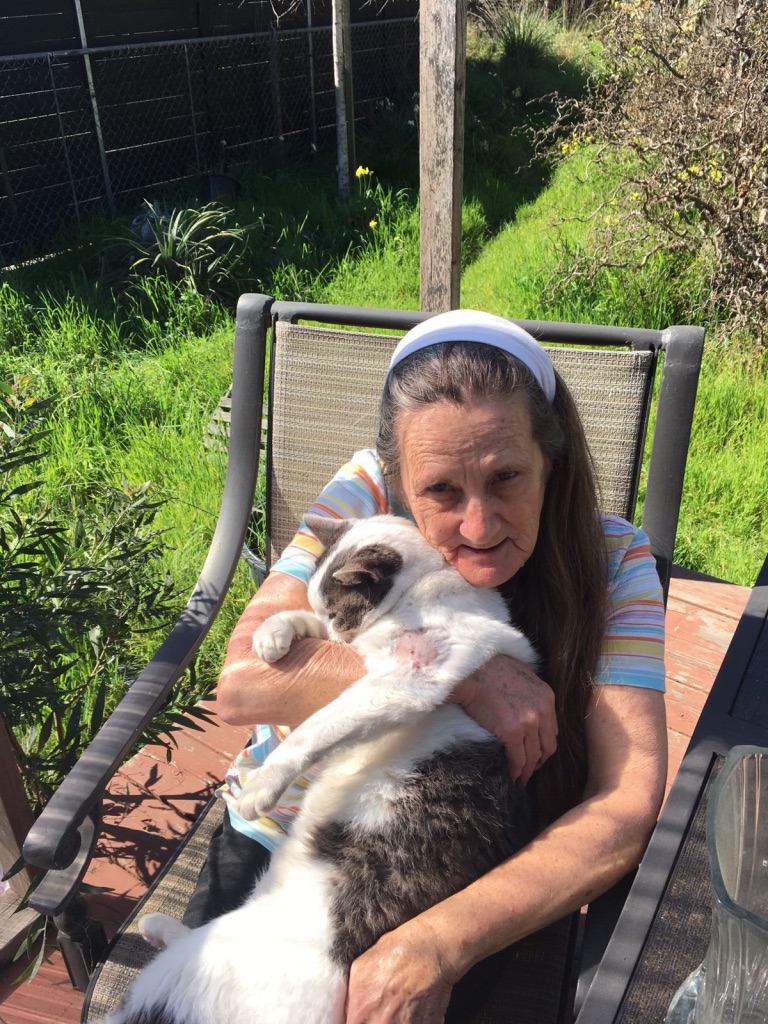
Gale and Clark
    The closest human to Clark besides me was my sister Gale.  When I left town she would come over from San Francisco to do the cat chores. Clark would climb onto her lab, Gale would tell him he was the finest cat in Alameda, and they would settle down together for a nap.  She agonized over him last November when he had a bad infection around his eyes, calling him "Le Pauvre."  An initial course of antibiotics produced scant improvement, and Gale demanded I return to the vet immediately to ask for better medicine.  The next time she came over we went to the vet together.  Gale broke into tears and pleaded with the receptionist to not let Clark die.

Clark with eye infection
    Gale, it should be added, is a schizophrenic.  She's been institutionalized much of her adult life, and taking care of Clark shows how much her world has expanded in recent years.  As do her tears, her concern for a vulnerable little creature.  She seemed emotionally muted before, but now she gives me lessons in caring about others.  Of course she was upset when Clark went to Pet Emergency, and I dreaded telling her he hadn't made it.  But she cared for me too, and said that it wasn't the end of the world.  There will be another cat.

    She's right.  Made a plan, as humans are wont to do: volunteer at the animal shelter; learn better Cat; be open to that spark of connection with my next feline companion.  Because when a major cat enters your life, you don't exactly pick them out, it's more like that you become entwined in a story.  Clark's arrival was certainly dramatic.
… … … … …
    2004 took a terrible turn for Jean.  Her good friend Sandra lived with her husband John in a two-story wood-beamed rustic house in upscale Mill Valley.  Every month Jean would visit her, and the two chums would go around to nurseries and select plantings for Sandra's garden.  Jean looked up to her, to them.  Both Sandra and John had doctorates in psychology, John was blessed with a photographic memory, and Jean valued Sandra's insights into life and love.  And for what it's worth, both were considered beautiful by American standards of physical appearance. But John took Prozac to manage his depression, and over time it stopped working.  In March he took his own life.

    Things got worse.  John had been the main breadwinner for the couple, the suicide exclusion clause on his life insurance had not expired, and Sandra could not afford the mortgage payments.  She told Jean she would kill herself before she would move. Jean tried to come up with ways to save her friend's house/life, ranging from finding good jobs she could apply for, to thinking of clever inventions they could patent, to asking for help from famous rich people.  None of the jobs panned out, the other schemes didn't even get off the ground.  Sandra told Jean that she was going to check out, that trying to stop her would accomplish nothing but to destroy their friendship.  I took the call from Sandra's sister and passed Jean the handset.  Her face went dark.

    Did she torment herself by wondering if she should have intervened?  Yes and no. For years she thought about it, talked about it, started a novel about it.  But she soon found other opportunities to save creatures, ones who wanted to live.  Once we were riding our tandem home from the ferry, and she heard feline sounds in a field of tall grasses. To my consternation, she insisted on getting off, finding the cat, and trekking to houses around the neighborhood to try to find where it belonged.

    That was in the summer, kitten season.  We had an outdoor cat we'd named Houdini because she'd escaped from the trap we set to capture her and get her fixed.  Houdini had a litter, and started bringing kittens around to our deck to eat. Jean had her own depression issues, and was spending a lot of time in the bedroom. But when she saw the kittens her eyes lit up, and she decided that two of them must now be indoor cats.  When she took them to the vet, some confusion on the forms led the vet to conclude one of them was named Lewis, Jean's last name.  Rather than argue, she decided to give the other a compatible name.  Enter Clark.

       … … … … …

    Jean loved to spend mornings doing computer work in bed, and then leap up catlike to dress and slip into her day.  She valued good snuggling in a cat, extra points for not curling up on the keyboard.  Clark got with the program.  He was the coziest bed cat, naughty only in small ways, like getting entangled in fabric when he would paw us just to be sociable.  Jean would purr "No claws mister," gently freeing him in a way that Clark took as grooming.

    He had one less endearing habit, climbing onto high shelves and knocking stuff down to make room for himself to spread out.  But broken crockery was a small price to pay for what he'd brought us, and Jean said it was just his way of asserting dominance over our other cats.  And he certainly outshone Lewis.  Both brothers were big, but Lewis was somnolent and timid, and so hefty as an adult he could not have climbed up to challenge Clark had he wanted to.  After our feisty tortie Zola wandered off in her old age, and our beatific tuxedo cat Felix died of heart failure, Clark truly was top cat.

       … … … … …

    8 years later, Clark to the rescue again. 

    In April 2011 Jean had brain surgery for a GBM, the worst kind of malignant brain tumor.  The surgeon removed all the tumor cells he could see, the she had radiation and chemotherapy.  At first she hoped to complete her Sandra novel while she convalesced, but discovered her interest in suicide had waned.  Instead, she wanted to write about her struggle to stay alive, and her friends and family were grateful for her emails and blog posts.  In June 2012 she had to tell everyone that the tumor had returned. Then in September, she was rejected from an immunotherapy clinical trial at UCLA because the tumor had crossed the corpus callosum into the left hemisphere.  By October I was writing all her news myself.  On December 7, Jean entered the Zen Hospice on Page Street in San Francisco.

    Hospices allow palliative care only, and Jean agreed not to pursue the one FDA-approved treatment her neuro-oncologist would still prescribe. But she thought of Tibetan herbs as her ace in the hole, while I pinned my hopes on cannabinoids, based on the research showing THC destroys tumor cells in test tubes.  The Zen Hospice was happy to administer alternative medications.

    And it seemed to work great at first.  Jean resumed writing, and received a parade of friends and colleagues at her bedside.  But the tumor was implacable.  By January she could only acknowledge visitors with her eyes, and answer yes or no questions by squeezing their hands.  Jean's close friend Yao, a DVM in South Dakota, pointed out that there was a visitor or two Jean would love to see, for whom language would not pose a barrier.
Jean and Clark holding hands at the hospice

Big Clark with Hospice Visitor
    And the Zen Hospice does allow pets during visiting hours — they do their utmost to accommodate the messy lives of the residents.  Sedate Lewis seemed the best candidate for keeping out of mischief in a institutional setting, and the very next time I popped back to Wood St. to set out food and water, I tried to coax him into a cat carrier.  He would have none of it; since Jean left he had been giving me suspicious looks and keeping his distance.  But Clark, as usual, was up for anything.

    It was weeks before he saw home again.  There were three good reasons why Zen Hospice bent their rules to allow Clark overnights: he raised Jean's spirits; he charmed everyone else; and he was the very model of feline decorum, most of the time.  He would hang out on Jean's sick bed, placing his paw in her hand, the two of them just breathing, letting the moment expand. He would greet visitors obligingly, allowing himself to be held and admired.  He never was even suspected of exploring another resident's rooms, or the
staff areas.  Well, hardly ever.  Once he disappeared for a couple of hours and was found hiding out underneath a reclining chair.  But by that time he was a resident, and there was not even a hint of eviction proceedings.

    Jean passed early in the morning on February 17. That evening, dozens of us crowded into Jean's room for what the Zen Hospice calls their bathing ceremony.  We took turns sprinkling her with flower petals, and trying to say a few words about what she meant to us.  Too many of us for Clark, but he strode out of hiding when the others had left.  Then we went back to Wood St. together to start our next phase.

       … … … … …

    
Clark, adapted to new household rhythms,
December 2015

Clark, New Years Day 2015, seated on the table
when I returned from a bike ride 
    We adapted to each other, in a household that felt as austere as a monastery, but as messy as a bachelor pad.  I'm not a bed-person, 7 hours sleep is quite enough, and then when the alarm goes off I'm up.  Clark didn't approve.  At first he kept his distance from the bedroom, but came to allow me to carry him in at night, and to ignore my abrupt wakenings in the morning and sleep-in.  And I learned some of what he had demonstrated at the hospice: the crucial importance of making time to do nothing but be with another creature.  I'd tug his ears, scratch his tummy, and tell him he was the companion animal par excellence.

    But we did fight an epic battle over his weight.  Lewis died suddenly of heart failure in June, and the vet said Clark was also at risk because he was flirting with feline obesity.  He was a big cat, but at 21 lbs. there was 50% more of him then there should be — his prescription rations were just 3/4 cup dried food per day.  When he wanted more, he would come up behind me and goose me in the armpit, or scamper around my feet when I walked around the house.  But after a year he was down to under 14.

    A success!  Thanks for letting me have that one Clark, helping you helped me through that grim time.  And thanks for everything you did for Jean and Gale. It would be comforting to say "see you on the other side," but can't really believe in that stuff.  But there's still some of this life left to me, and I hope to live it with some of the compassion that seemed to gather around you.


Friday, May 25, 2018

Poem needed for Honor and Celebrate Ceremony at upcoming Brain Tumor Walk

    The National Brain Tumor Society is looking for a new poem to read at the Honor and Celebrate ceremony, June 24, during the Brain Tumor walk at Crissy Field in San Francisco.  If you know a poem that is suitable for a memorial service, or that helped you in a time of wild grief, please post a link to it on this blog piece or on my Facebook timeline. The deadline is Sunday June 3, and you will receive a small prize if the Brain Tumor Walk executive committee selects a poem you nominate.

    Here's some background.

    For the past two years we have been using Epitaph by Merritt Malloy for the ceremony.  The bar is high:

Epitaph
   by Merritt Malloy

When I die
Give what’s left of me away
To children
And old men that wait to die.
And if you need to cry,
Cry for your brother
Walking the street beside you.
And when you need me,
Put your arms
Around anyone
And give them
What you need to give to me.

I want to leave you something,
Something better
Than words
Or sounds.

Look for me
In the people I’ve known
Or loved,
And if you cannot give me away,
At least let me live on your eyes
And not on your mind.

You can love me most
By letting
Hands touch hands,
By letting
Bodies touch bodies,
And by letting go
Of children
That need to be free.

Love doesn’t die,
People do.
So, when all that’s left of me
Is love,
Give me away.

    We are only looking for a different poem only because nobody wants to hear the same thing year after year. From the perspective of a rank amateur, here are what I see as its strong points for our purposes.

• It's short.

• The language is simple and accessible, and has a liturgical feel well-suited for the ceremony.

• The poem doesn't try to deny the pain of loss, it expresses it, allows it to resonate.  That is, it's light on the saccharine.

• On the other hand, the pain is not so raw and corrosive that it could only be expressed privately.  For example, these lines about a loss experience probably would not work, powerful as they are.

  …Bees in the heart, then scorpions, maggots, and then ash.
  He climbed onto the jumping girder of the bridge
    — from Faint Music by former Poet Laureate Robert Hass

• It's not tied to a particular tradition.  There are many good Buddhist poems about death, but not everybody is a Buddhist.

• It's told in the voice of the departed, using loving memory as a path from grief. 

    None of the replacement poems I've read work quite so well.  For what it's worth, here are three of them, with strong and weak points noted. Take my opinions with a dollop of salt.

After Words by Kimberly Blaser

    This one actually might work.  Great title, and these lines near the
start tell of an experience burned in many of our memories:

    … Because one night I was in a room
    listening until only one heart beat.

    And it has a liturgical feel, beginning with sentences starting with "Because," and ending with sentences starting with "And if."  Moreover, the language is simple. But it's told from the viewpoint of the survivor, and grief is reconciled by accepting impermanence. Is everyone ready for that?  Imagine the opening and closing lines spoken aloud at the ceremony:

    Because the smallness of our being
    is our only greatness

    …And if death is a foreign state
    we should loosen allegiance to this one.
    And if the soul leaves our body
    then we must rehearse goodbye.

The Change by Denise Levertov

    We actually read this one at Jean's memorial service.  It's a beautiful poem by a revered poet.  In broad strokes, its theme is much like Epitaph's, transmuting grief by imagining the departed living on by expanding the worlds of the living.  But like After Words, it's told from the standpoint of the survivor, and includes one uncommon word, "arpeggio."  And the pain in the beginning might be too real, too raw:

    For years the dead
    were the terrible weight of their absence,
    the weight of what one had not put in their hands.
    Rarely a visitation — dream or vision —
    lifted that load for a moment, like someone
    standing behind one and briefly taking
    the heft of a frameless pack.
    But the straps remained, and the ache—
    though you can learn not to feel it,
    except when malicious memory
    pulls downward with sudden force

    "malicious memory"? Know about that one — too many beans, not enough ice cream, as the if-I-could-live-life-over-again homily has it.  And probably most people do experience keen regrets.  But would we confess together at the ceremony?

When Death Comes by Mary Oliver

    Another great poem by a revered poet.  And it does have a liturgical feel, with four repetition of the phrase "when death comes" near the beginning. However, it's more about living fully, and accepting mortality, than about working through grief. Or is that being too narrow?  Consider these lines:

    … And therefore I look upon everything
    as a brotherhood and a sisterhood,
    and I look upon time as no more than an idea,
    and I consider eternity as another possibility,

    and I think of each life as a flower, as common
    as a field daisy, and as singular … 

    Could you read that as a way to accept loss by realizing that everyone is beautiful, everyone part of something larger than themselves?  Oliver ends that sentence with these stanzas:

    … and each name a comfortable music in the mouth,
    tending, as all music does, toward silence,

    and each body a lion of courage, and something
    precious to the earth. …

    "A lion of courage." Think of brave Jean every time I read those words,
dwelling a  moment in her memory.


Sunday, May 13, 2018

𝓓𝓲𝓪𝓻𝔂 𝓸𝓯 𝓪 𝓟𝓸𝓭𝓬𝓪𝓼𝓽 𝓙𝓾𝓷𝓴𝓲𝓮 — Edwidge Danticat reads "Without Inspection" ⭐⭐⭐⭐⭐


    If you have 38 minutes for an intense literary experience, consider listening while Haitian-American writer Edwidge Danticat reads her short story Without Inspection in the May 8 edition of the New Yorker's Writer's Voice podcast.

    The three main characters crossed from Haiti to Florida by boat and swam ashore, and the title is the term for someone who did not ask permission before entering the U.S.  So you could say the story explores the world of the undocumented.  If you need more reasons to loathe Don, or to believe that the Dreamers deserve a chance to stay in America, this story can do it for you.  It bears emphasizing that Danticat hails from a place the President famously dubbed a "shithole country."


    Or you could say the story is about understanding that "there are loves that outlive lovers," letting those words resonate, imagining how wanting them to be true could be the most important thing in the world.  The phrase appears to Arnold, the protagonist, as he finishes saying goodbye to images of the two people he loves most, the only two he really has.  It's so sad that calling it sad seems lame.  Turns out the world of the undocumented is much like everyone else's, but with the danger settings on high.

Tuesday, March 6, 2018

Five Years After — Memories of Jean

Jean Lewis leaving Wood Street to go to a meeting of the Heritage Rose Foundation

    My neighbor Anne, a seamstress, saw me in front of the house last week and came over to talk.  "The Stitches show was in Santa Clara last week," she said.  "Six years ago Jean went with me and we had a great time, and afterwards we said we'd do it again next year.  But then ... ."  We hugged, and said a few words about what a wonderful person Jean was; and how much she would have loved to see the progress on the park they've started building at the end of Wood St.


    Happens to me a lot, people volunteering their memories of Jean.  And there are reminders around the house everywhere I look.  The picture above is on the fridge.  One Sunday she was rushing off to a Heritage Rose Foundation meeting, and I insisted that she pause on the front porch for a picture.  It was so typical, it had to be immortalized: the quiet hurry; the inevitable cup of coffee; the quirky elegance of the bouquet in a backpack; her sociable purpose, preserving the beauties of an ailing planet.

    Other memories seem to jump out of hiding.  I could be searching for a recent email from someone, and find correspondence with Jean instead.  Like this one, Jean writing to a friend in September 2012, after the NovoCure treatment on which we'd pinned our hopes had failed, and the tumor and crossed the corpus callosum into her left hemisphere.  She apologizes for not communicating enough, then acknowledges the bad news.  And, before finding kind words to say about her medical caregivers — she gets excited about her next garden project, which she envisions improving her spirits and her health.


I've got to get better about keeping up my blog!  Yes, I'm very disappointed; just yesterday for the first time I finally thought maybe I won't make it, but I still hope I can find a way... [She worries how I'll cope without her]  As therapy for myself, I'm planning a huge garden project that sounds like fun, to me, anyway, and should get me back in shape and keep me occupied happily for a while: "paving" the entire back yard--not with cement, but pervious, reused materials.  I wi'll also dig a trench to the back to make a rain garden to help the stormwater percolate into the ground.  Figured I'd try to use all recycled materials and dig out the soil down a few inches, filling in with decomposed granite or sand.  I got a couple of mosaic books, typical of my recent experiences, I accidentally got two books--both are good, though---just more ideas.  I think it will be fun, and one of my close friends from Ann Arbor offered to come out to visit and help with this project, and just hang out with me, so that should be fun, and is certainly something good for me to look forward to!  UCSF did not offer much in the way of options, but we spent some time with one of their social workers today (She's great!) so I, at least, feel better now.

    Certainly that deserves an award for calm courage and bright spirit in the face of life threatening illness.  

    Postscript. The rain garden Jean planned is in place, with one change.  Instead of all the water percolating into the ground, some of it is stored to irrigate the orchard during the dry months.  I had forgotten about the mosaic, but there's a good place for it around the bird bath.


Sunday, February 18, 2018

Five Years After — Remembering Jean


Gabe with bouquet at Jean's grave
Saturday February 17, 2018

    Saturday marked five years exactly since Jean passed, and my elder son Gabe came with me to Oakmont cemetery to tell her our news, and thank her for her blessings.  No, we're not daft, but Oakmont is a beautiful spot with expansive views and interesting landscaping, and it is easy to imagine her presence there. So we just go to her grave and start talking.

    Gabe's news is very good indeed.  Of course he's reading piles of serious books and pursuing his writing, Gabe is Gabe, and he's also training to run a half-marathon.  And, Tuesday he'll start a job with a solar panel company.  He
Everything in the bouquet was from 
Wood St. — Jean appreciated the white 
blossoms from our plum tree, and was 
glad we did not bring her one of those 
lifeless florist bouquets with large, perfect,  
odorless roses.

aced the interview, and likes the idea of getting his foot in the door in the green technology industry.  Jean has certainly loved hearing about all the positive developments in his life over the past two years.


    And about Gabe's kid brother Sam.  Saturday marked two years, five months, and fourteen days that Sam has been clean and sober.  He's working a full-time job, two part time jobs, supporting his son Nate, and volunteering as a drug counselor and sobriety instructor to boot.  A huge change from the addict nightmare, when he appeared to be pounding on death's door demanding to be let in.

    Nothing so dramatic to report about my life, but I did have a blessing to thank Jean for.  Being an adjunct Computer Science prof is an ideal job for me, except for one little thing.  Or actually not so little — you need to be a great self-editor, tests with no typos, that sort of thing.  Not exactly my strong suit, but editing was something Jean was uncannily good at.  And the first midterm of the SFSU semester was scheduled for Friday the 16th.  Help!

    It seemed like we communicated a lot last week.  Most nights she appeared in my dreams, big productions with journeys and intense conversations, where she told me she would not come back to me, and seemed to be urging me to face forward.  During the days, I told her "If I can't have you back, could I at least internalize a bit of your editing skills?"  That is if I do my part of course, multiple proofs, etc.  It seemed we struck a deal.  There was only one questionable question on the midterm Friday, and that was just because the format was slightly different from others on the same topic.  Thanks much, Jean Mary Lewis.

Saturday, January 13, 2018

Another week, another vigil — the Alameda Progressives keep watch on an ailing democracy

Downtown on the Island, Saturday January 13, 2018
Sherry, the self-styled

walking billboard. 
"What do I hate most 
about Trump?  The 
racism.  Number two
would be the lack of
decorum."
      Motorists honk to show support, at least one person gives us money, nobody jeers.  As they have since last January, the Alameda Progressives stand on the corners of Park and Santa
Cathy.  "My biggest problem
with Trump is the way he
betrays the people who voted
for him thinking he would bring
back their jobs"
Clara holding signs raising a few little issues with the Trump Administration.  Stuff like racism, climate change denial, the drift toward nuclear war with North Korea, the decay of democratic norms … and the impression, growing into certainty, that the country is being led by a low-life.


Katie.  "From day 1 he was an

unconstitutional president, and he has 
been eroding our democracy ever since.  
That's why the Alameda City Council 
passed a resolution for impeachment last 
March 17, the 2nd city in the Bay Area
to do it after Richmond.
Rosemary.  "What I
dislike most about him
is his flagrant disregard
for the constitution.  
There is a chance for 
impeachment, some 
Republicans may support it.

      There were 14 of us this time, more than usual due to the MLK Day theme.  And if your planning on going to the Women's March next Saturday, the Progressives will be there too, collecting signatures to put Gayle McLaughlin (Lieutenant Governor) and Pamela Price (District Attorney) on the ballot.
The vigil ends with gathering in a circle, and pledging to commit
ourselves to the struggle for human dignity.


Wednesday, January 3, 2018

Starting off with a binge

New Years toast at Glenn and Ahn's place. 

    It was frenetic, exhausting; it was desperately trying to prove a point, whatever that point was.  And it was exhilarating while the energy lasted.


    The fun started 11 Sunday morning with a bike ride to the Jack London Square Amtrak station.  To me, the high vaulted ceilings have an energy like an expansive mood.  15 other passengers waited on the platform, and there wasan excitement in the air that you would never find at a gas station, or a line of cars creeping toward a toll both.  We boarded the San Joaquin bound for Sacramento, and for two verypleasant hours I watched watery landscapes drift by and made notes in my journal.


    The Sacramento Valley Amtrak station is a major rail hub, with different gates, like at an airport.  From there, my GPS guided me on a 10 mile ride cross town via the Jedediah Smith bike trail, to my brother Glenn's house.  Glenn and his sweetie Ahn were throwing a big dinner party, and I was put to "work" preparing food — my exertions consisted only of riding with Glenn to pick up trays of food at a Vietnamese delicatessen, and of slicing a tray full of cucumbers and cherry tomatoes.

Ahn
Glenn
    Dinner started at 6:30, and then course followed course.  One guest, Ray, is a colleague of Glenn's in the American River College math department, and we three indulged in shop talk about grading.  As well as some grousing about millennials, each and every one madly in love with their smartphones.  Another guest, Andreas, is an M.D., who has had a front row seat for viewing the opioid epidemic.  His specialty is physical medicine (as in recovery from injury), and he recalled that not too long ago, he was instructed that pain is the 5th vital sign, and that opioids prescribing based on patients reported pain level carried no risk of addiction.  Combine that with the legal fact that there is no limit on damages claimed due to pain and suffering, and voila! An epidemic.  Not imported from Mexico, as Trump would have it, but dispensed at our own native pharmacies.  Someone asked me if I had any resolutions for 2018, and I said only one, IMPEACH HIM.  No one demurred.
Mamu, an exquisite creature
and reglal presence in the
Glenn & Ahn household

    And nobody complained at my skulking away at 9:30 to go to a contra dance.  Single sexagenarians have their rights.  At midnight, we dancers greeted 2018 with raised glasses of sparkling apple juice, and sang Auld Lang Syne. I got lucky and found a charming partner for the last waltz.

    The next morning Glenn got up after only 5 hours sleep to give me a ride to the train station.  There followed two more pleasant hours watching scenery, followed by a bike ride the long way back to Alameda: east along Embarcadero across the Park St. bridge, then back west along Clement. Somehow the extra pedaling was part of the point, could easily have taken the 51A.  But after that, time was tight, and there were two NYD parties to go to.  I transformed into motorist Americanus.

   The first party was was at the home of my friends Nick and Ronnie in El Cerrito.  There must have 20 guests mingling around their table, drinking wine and sampling delicacies.  It was a lively crowd. Talked with a woman named Joleen, whose Ph.D. thesis was about how Melville's Moby Dick owed much to Milton's Paradise Lost.  Ahab as Satan.  And Trump as Ahab?  Tried my New Years Resolution line about impeachment, and just got a worried head shake.  Nice idea, never happen; seems we're doomed to confront our captains white whale.  At 3 I left for the last event in my social pentathlon (more or less), a music party at the home of John and Sue in San Jose.
Fiddlers at John and Sue's music party. 
Sue is the one on the right with blonde hair.

    A half dozen musicians played their fiddles, while the rest of us enjoyed the music, chatted, drank champagne punch, and ate black-eyed peas and collard greens for good luck. It was dark by the time I started home, and  truthfully, there were times when lane markers seem to waver. But I gripped the wheel tightly and commanded my brain overrule my eyes. The point became make it home without being a fatality or causing one.  Point taken.  Home by 7, slept for 10 delicious hours.

Fourth of July parade in Alameda, that bikable city

  City of Alameda Notables The Alameda 4th of July parade is a source and expression of civic pride. At 3.2 miles, we say the east side to w...